Odd AlmanacSearch

More than one kind of elsewhere

Quantum branches, distant cosmic regions and the limits of a useful metaphor.

3 entries

Editorial illustration: a branching tree of paths
Editorial illustration · Z13 visual study

Multiverse names a family of proposals rather than one established discovery. Different accounts disagree about what another world is, why it would exist and whether it could be observed. The Cabinet keeps those distinctions visible before making connections to dreams, consciousness or fictional worlds.

Separate the proposals

A reading route into physics and interpretation, with speculation identified.

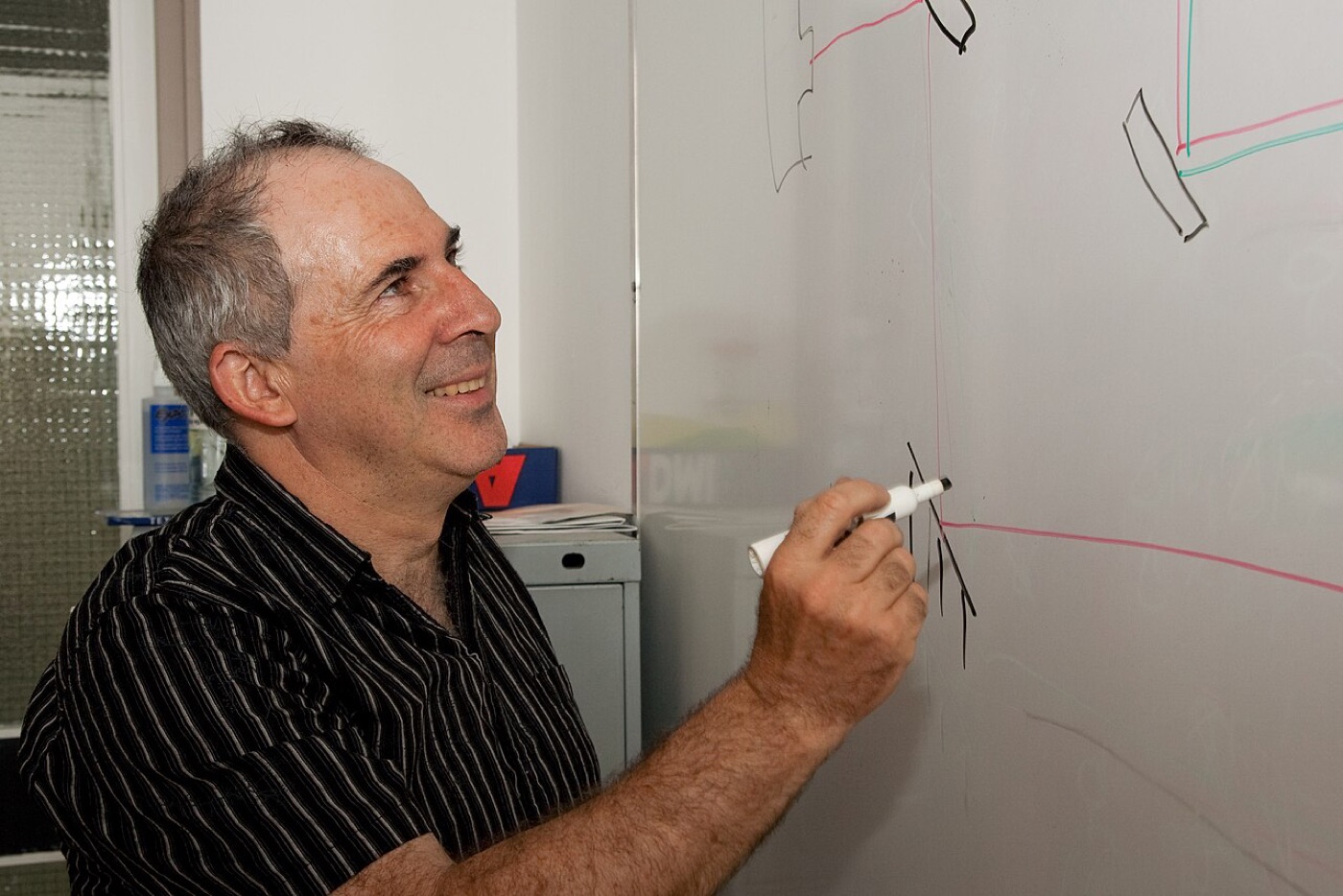
Grey-haired man smiling and drawing on a whiteboard
Lev Vaidman, author of the cited Stanford Encyclopedia entry on the many-worlds interpretation, in his office at Tel Aviv University, 4 May 2009. Yairm · CC BY-SA 3.0

Theory & argumentPhilosophy of physics · 2002; revised 17 June 2026

Everettian worlds · An interpretation of quantum theory

Vaidman’s encyclopedia entry on many-worlds: a quantum state with no added collapse, and the separate problem of matching it to experience.

Many-worlds approaches retain a quantum state evolving without an added collapse. Vaidman’s encyclopedia entry distinguishes that mathematical description from the further problem of relating it to definite experiences. Popular images of branching histories can help orientation, but they are not evidence that a person can step into another branch.

Source details & what was checked
Man with shoulder-length brown hair in a black leather jacket speaking at a press-conference table in front of Web Summit branding
Max Tegmark at Web Summit, Lisbon, 13 November 2024. Later photograph than his 2003 article. Web Summit · CC BY 2.0

Theory & argumentCosmology proposal / review · 2003

Tegmark · Four different multiverses

Tegmark’s four-level classification of parallel universes, from distant regions to other mathematical structures: a way to ask which multiverse someone means.

Tegmark’s four levels are regions beyond our observable horizon, regions with different physical constants, quantum branches and different mathematical structures. They do not stand or fall on one piece of evidence. The classification helps you ask which proposal a speaker means before evaluating the claim.

Abstract and bibliographic record reviewed; this entry is a reading lead into the full paper.

Source details & what was checked
  • Max Tegmark · 2003
    arXiv abstract and bibliographic record inspected 19 October 2026; full paper not reviewed for this addition. The four-level classification includes regions beyond our horizon, different physical constants, quantum branches and other mathematical structures; these have different assumptions and evidential status.
    Parallel Universes (external source, opens a new tab) · In the source library

Editorial illustration: stacked waves between two points
Editorial illustration · Z13 visual study

Commentary & interviewScholarly overview · Living encyclopedia entry

Where consciousness enters—and where it does not

Why quantum physics in the brain and multiple worlds are separate proposals: a route through Orch OR, decoherence objections and Atmanspacher’s overview.

A proposal about quantum physics in the brain differs from a proposal about multiple worlds. The consciousness chapter covers Orch OR, decoherence objections and information-based approaches; Atmanspacher’s overview offers another route through the distinctions. None of these references by itself proves that awareness travels between universes.

Free reading: the linked 2011 exposition is an earlier work, not the 2014 review.

Source details & what was checked