Odd AlmanacSearch

Astral projection and other planes

Occult maps, out-of-body accounts and an Army attempt to translate the territory into physics.

4 entries · 2 sections

Editorial illustration: a row of moon phases
Editorial illustration · Z13 visual study

Other planes enter this collection through several doors: a Theosophical taxonomy, Monroe’s exploration narrative and Gateway’s proposed scientific vocabulary. Their overlap with remote viewing includes actual people and institutions. A reported experience, a map explaining it and a physical dimension are related questions, not interchangeable descriptions.

Three ways to describe elsewhere

A Theosophical taxonomy of 1895, Monroe’s 1971 out-of-body narrative and a 1983 Army assessment, each describing elsewhere in a different vocabulary.

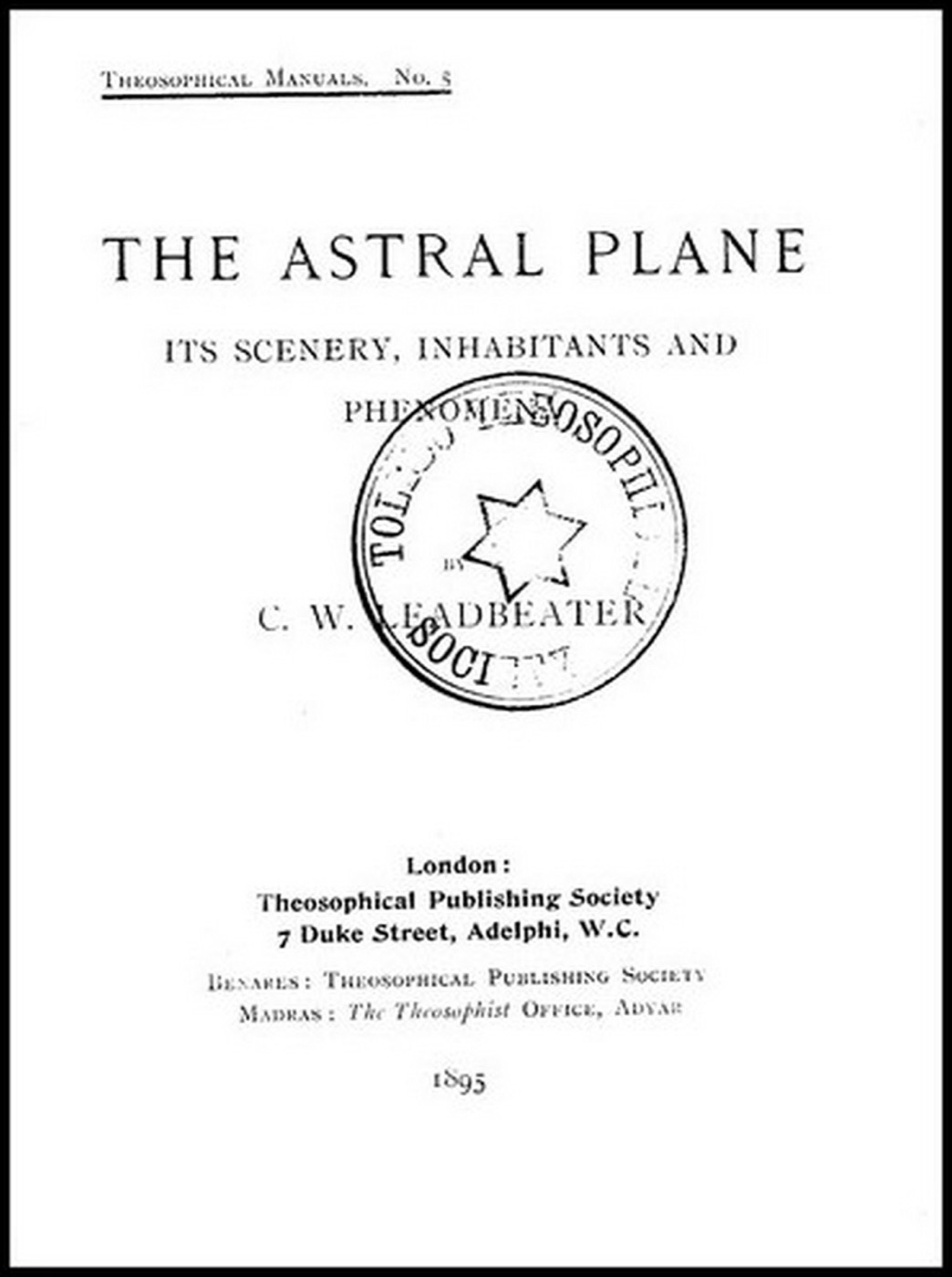
Printed title page of The Astral Plane by C. W. Leadbeater, 1895, with a circular library stamp over the lower half
Title page of the first edition of C. W. Leadbeater's The Astral Plane: Its Scenery, Inhabitants and Phenomena (Theosophical Publishing Society, London, 1895), from a copy bearing a Toledo Theosophical Society library stamp. Charles Webster Leadbeater (author); scan of the 1895 first edition · Public domain

Tradition & esotericPrimary Theosophical text · 1895

1895 · A plane with its own scenery

Leadbeater’s 1895 text surveys the astral plane like a naturalist’s field guide; a Theosophical cosmology, not an experimentally specified dimension.

Leadbeater’s The Astral Plane treats an invisible environment as something that can be surveyed: subdivisions, inhabitants, distinctive perception and phenomena. Its detailed taxonomy is part of the appeal, making otherworldly experience resemble a naturalist’s field guide. He sometimes compares astral vision with sight in a fourth dimension, so dimensional language is already present in this nineteenth-century source. Here a plane belongs to a Theosophical cosmology, not a modern, experimentally specified extra coordinate. The link is historical vocabulary crossing spiritual and scientific imaginations long before quantum-computing culture.

Primary spiritual cosmology; its fourth-dimension comparison is the author’s proposal.

Source details & what was checked
Editorial illustration: a row of moon phases
Editorial illustration · Z13 visual study

History & recordFirst-party institutional account · Institutional retrospective; 1971 book

1971 · Monroe describes leaving the body

The Monroe Institute’s account of Monroe’s experiences from 1958, which he read as out-of-body, and his 1971 book; first-party history, not proof.

The Monroe Institute’s account traces Robert Monroe’s interest to experiences beginning in 1958 that he interpreted as out of body. His Journeys Out of the Body appeared in 1971, turning private episodes into a public exploration narrative. The emphasis shifts from a pre-existing occult map to an experiencer describing apparent movement beyond ordinary bodily perspective. The continuity with Lilly is an investigator presenting consciousness as territory to explore. Monroe’s institutional history supplies the provenance and interpretation; an experience of being elsewhere and a demonstrated journey to an independently existing location remain different claims.

First-party experiential history; the full 1971 book was not reviewed for this entry.

Source details & what was checked
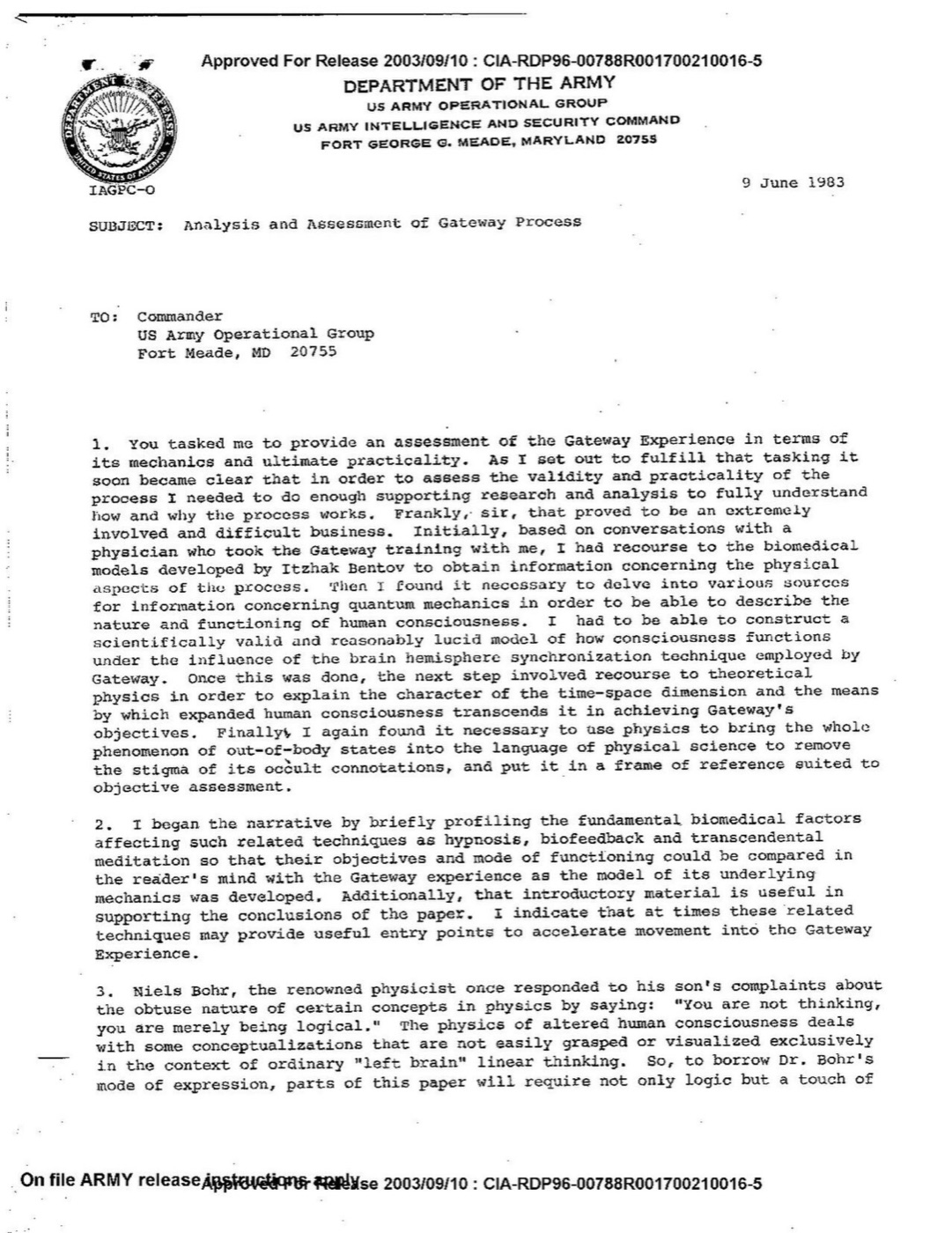
Typewritten Department of the Army memorandum on US Army Operational Group letterhead titled Analysis and Assessment of Gateway Process
First page of 'Analysis and Assessment of Gateway Process', US Army Operational Group letterhead, Fort George G. Meade, dated 9 June 1983, by Wayne M. McDonnell; CIA Reading Room copy approved for release 10 September 2003 (CIA-RDP96-00788R001700210016-5). Wayne M. McDonnell; CIA FOIA Reading Room scan · Public domain

History & recordDeclassified Army theoretical assessment · 9 June 1983; release stamp 10 September 2003

1983 · The Army’s Gateway assessment

A 1983 US Army assessment of the Gateway Experience in biomedical, quantum and holographic terms; theory, not a controlled demonstration.

The document commonly circulated as the CIA Gateway report begins on US Army letterhead, addressed to the commander of the US Army Operational Group. Dated 9 June 1983, it assesses the Monroe-associated Gateway Experience using proposed biomedical, quantum and holographic explanations. Its author treats out-of-body information gathering and encounters with noncorporeal intelligence as possibilities worth considering. It is an unusually direct archival meeting of altered consciousness, physics vocabulary and intelligence interests, but records an enthusiastic theoretical assessment and proposed investigation, not a controlled demonstration that consciousness travelled outside spacetime.

Declassified Army assessment; CIA archival custody and release do not convert its proposals into agency-validated findings.

Source details & what was checked
Back to sections ↑

A documented bridge to remote viewing

A Monroe Institute photograph caption placing Monroe, Pat Price and Russell Targ at SRI, offered as a concrete bridge between out-of-body and remote-viewing trails.

Editorial illustration: three overlapping circles
Editorial illustration · Z13 visual study

History & recordFirst-party history and archival caption · Retrospective; circa 1974 photograph

The Monroe–SRI connection is more than a rhyme

The Monroe Institute’s caption naming Monroe, Pat Price and Russell Targ at SRI, circa 1974; a link between out-of-body and remote-viewing stories.

The Monroe Institute’s history page captions a photograph as Robert Monroe, Pat Price and Russell Targ at SRI, circa 1974. That is a concrete institutional bridge to the remote-viewing trail already in this collection: Targ coauthored the 1974 sensory-shielding paper, and Price appears in the programme’s history. The shared setting helps explain why leaving-the-body narratives and remote perception are often discussed together, though they differ: an out-of-body experience concerns where the self seems located; remote viewing concerns purported access to hidden information and need not entail a journey.

Historical connection; the SRI identification comes from the Institute’s own archival caption.

Source details & what was checked
Back to sections ↑