Odd AlmanacSearch

The library that seems to contain everything

Library of Babel: a literary labyrinth, an enormous space of possible pages and the strange feeling of finding yourself in it.

6 entries · 3 sections

Editorial illustration: honeycomb hexagons, one lit
Editorial illustration · Z13 visual study

Jonathan Basile’s Library of Babel turns Jorge Luis Borges’ imagined library into a navigable website. It feels like a place with no outside: corridors of addresses, unreadable books, and an improbable glimpse of something familiar. “Infinite library” is a useful feeling to begin with, but the website’s defined alphabet and page length describe a finite, extraordinarily large space.

A first visit

Two small steps into a very large place.

Editorial illustration: honeycomb hexagons, one lit
Editorial illustration · Z13 visual study

WebsiteInteractive text search · Undated live edition

Find a phrase you just invented

A first visit: search for “a quiet room”, open an exact-match result and watch your phrase acquire a shelf and volume.

Choose Search, enter “a quiet room”, then open an exact-match result. Seeing your sentence assigned a shelf and volume is the first little jolt. Search also offers surrounding random characters or words.

This exact search was tested on 20 October 2026. Use a made-up phrase; there is no need to enter personal information.

Source details & what was checked
Editorial illustration: a dashed route across city blocks to a pin
Editorial illustration · Z13 visual study

WebsiteLiterary web experiment · Undated live edition

Keep an address, not a trail of guesses

Search results give a hexagon, wall, shelf, volume and page, turning a peculiar string of characters into somewhere you can find again.

Search results identify a hexagon, wall, shelf, volume and page: ordinary library language that gives a peculiar string of characters a place. Follow a result’s location to see where the page sits; use the library’s own bookmarkable link when it offers one for a long address.

The location labels were observed in the tested search. Try an exact-match result first.

Source details & what was checked
Back to sections ↑

What is the library doing?

A computational construction with a literary atmosphere.

Editorial illustration: a grid of cells, some filled
Editorial illustration · Z13 visual study

WebsiteCreator explanation · Undated live edition

An enormous alphabet space

Jonathan Basile’s account of how the library’s locations stay reproducible without storing every 3,200-character page separately.

Basile describes pages of 3,200 characters using lower-case English letters, spaces, commas and full stops. A procedure makes locations reproducible without storing every page separately. The result can contain a chosen phrase alongside a vast amount of gibberish.

This is the creator’s account of the construction. It is not an infinite archive of scanned books.

Source details & what was checked
Editorial illustration: an open book
Editorial illustration · Z13 visual study

WebsiteCreator explanation · Undated live edition

Why finding a sentence feels uncanny

Curated interpretation: a found sentence feels like a message because readers bring expectations, yet the space also holds false statements and nonsense.

Our reading: a found sentence feels like a message because readers bring expectations and context. But a space of every permitted combination also includes false statements, contradictions and nonsense. Finding words here does not make them true, predicted or intended for you.

Curated interpretation. A parallel with language models concerns how readers experience meaning; the library does not work like an LLM.

Follow the subjects
Source details & what was checked
Back to sections ↑

Borges and impossible architecture

The literary structure has its own puzzles.

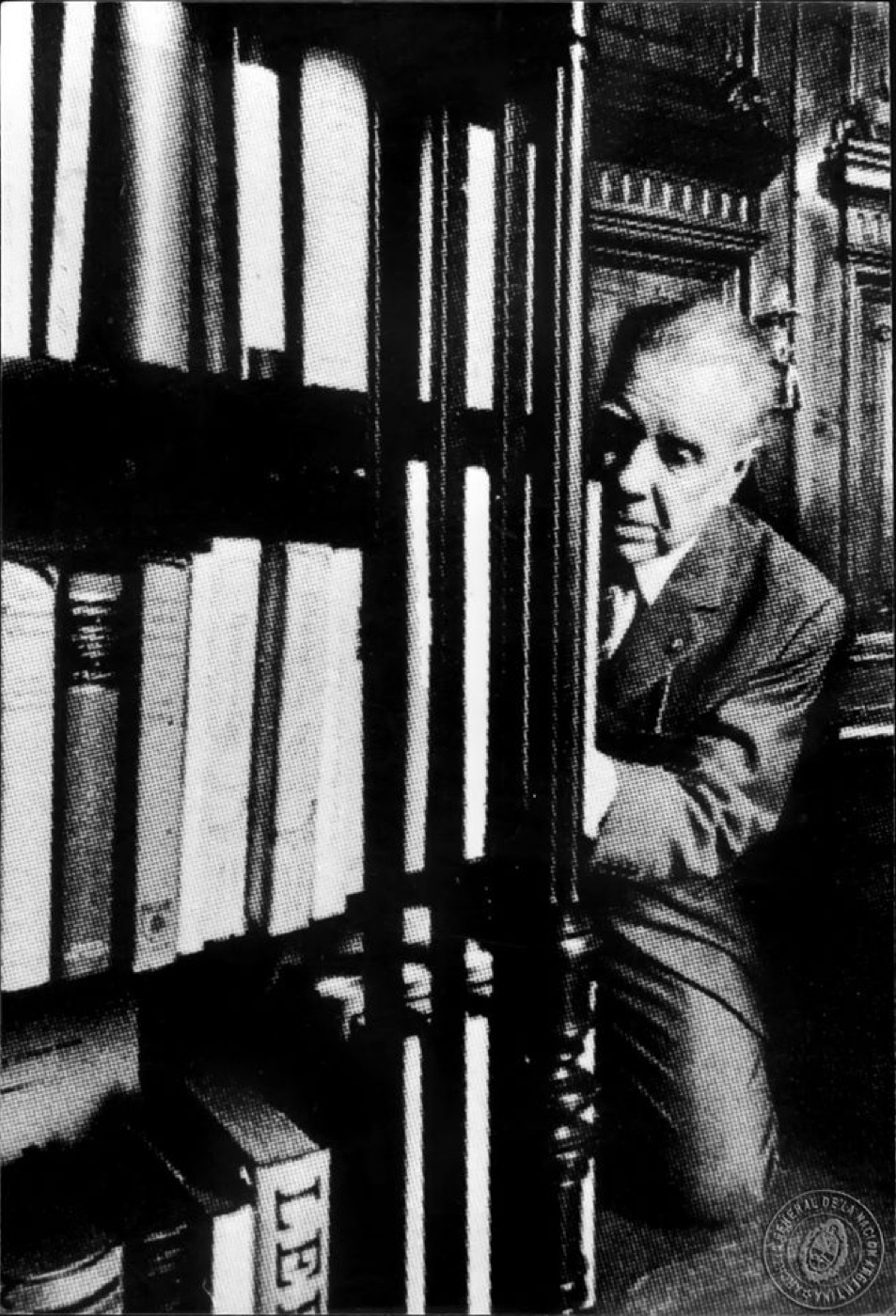
Black-and-white halftone photograph of an elderly man peering past a revolving bookcase, with an archive stamp at lower right
Jorge Luis Borges at the Biblioteca Nacional, Buenos Aires, 1973 (photograph by Sara Facio, Archivo General de la Nación). Borges directed the library from 1955 to 1973; his story 'The Library of Babel' dates from 1941. Sara Facio (Archivo General de la Nación Argentina) · Public domain

WebsiteCreator explanation · Undated live edition

A story becomes somewhere to visit

Borges’ 1941 story of hexagonal galleries and a limited alphabet, made navigable by Basile: imagining a library becomes using one.

Borges’ 1941 story supplies the hexagonal galleries and the idea of books drawn from every possible arrangement of a limited alphabet. Basile’s website makes the metaphor navigable; the shift from imagining a library to using one is part of its appeal as internet art.

Literary premise and creative adaptation; no claim that this is a physical place.

Source details & what was checked
Editorial illustration: a receding corridor ending in a lit doorway
Editorial illustration · Z13 visual study

Art & literatureLiterary interpretation · Undated live edition

Where do the corridors go?

Basile’s literary criticism on how Borges’ galleries could connect, and whether a place can feel endless when its joins are unclear.

In Why Hexagons, Basile examines how the galleries could connect and how small details in the story change the architecture a reader imagines. The question is spatial as much as numerical: can a place feel endless even when you cannot tell how it joins up?

The linked essay is literary criticism and includes references to other Borges stories.

Source details & what was checked
Back to sections ↑