Added · Daily discovery
On 16 November 1974, a radio telescope in Puerto Rico sent a small picture towards a distant star cluster. It did not transmit a photograph. The Arecibo message was a sequence of 1,679 binary digits, with changes in radio frequency carrying its ones and zeros. Arranged correctly, those digits became a compact introduction to the people who had sent them.
Maura Sandri’s explainer for Italy’s National Institute for Astrophysics describes the puzzle hidden in the message’s length. The number 1,679 is the product of two primes, 23 and 73. A rectangular arrangement with 23 columns and 73 rows produces the intended picture; exchanging those dimensions does not. This was a proposed way to organise an unfamiliar signal, rather than a test showing that an extraterrestrial reader would understand it.
The design moves through several kinds of information. It includes numbers from one to ten, atomic numbers for elements important to life, a schematic DNA double helix and a human figure. Farther down are a representation of the Solar System and a diagram of the transmitting telescope. INAF’s page explains the image section by section, making the encoded picture easier to read.
Cornell’s 1999 retrospective places the broadcast at a ceremony marking an upgrade to the telescope. It lasted roughly three minutes and was aimed towards Messier 13, the Great Cluster in Hercules. Donald Campbell, who worked at Arecibo in 1974, described the event as a symbolic demonstration of what the equipment could do. The account credits Frank Drake, Richard Isaacman, Linda May and James C. G. Walker, with contributions from Carl Sagan and others.
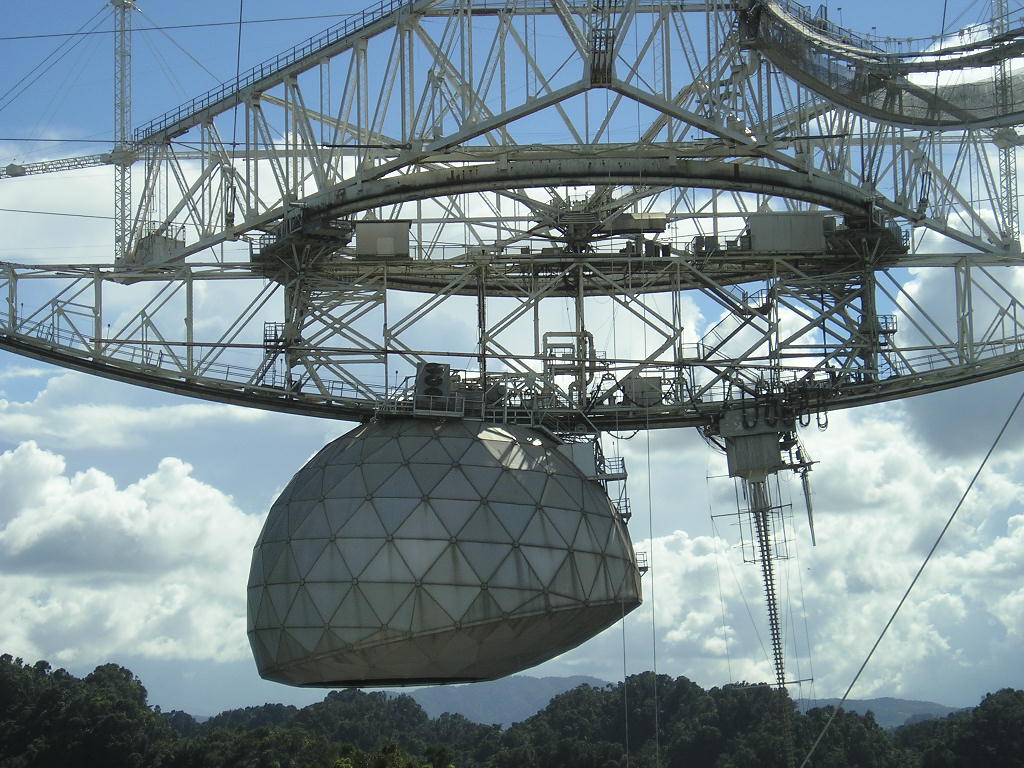
The photograph here shows Arecibo’s suspended feed structure much later, not the 1974 ceremony or the message itself. Start with Cornell for the recollections and engineering context, then INAF for the numerical design. These sources document a transmission made by humans; they do not establish that anyone received or decoded it.
A historical transmission, not evidence that an extraterrestrial recipient exists or decoded the message. The photograph shows later telescope hardware.
Source details & what was checked
- Bill Steele / Cornell Chronicle · 12 November 1999
Full Cornell Chronicle article and editor’s note read, including participant recollections, 1974 event, encoding, duration and named contributors. Free substantive HTML without account/paywall. Outdated first-and-only wording is corrected by its own editor’s note; this draft does not repeat it. Cluster-motion claim omitted because not needed and disputed elsewhere. Legacy outbound branches not followed or certified.
It’s the 25th anniversary of Earth’s first attempt to phone E.T. (external source, opens a new tab) · In the source library - Maura Sandri / INAF – Istituto Nazionale di Astrofisica · Undated webpage; text marks the 46th anniversary of the 1974 transmission
Full INAF educational article read: author Maura Sandri, factorisation, row/column arrangement, section-by-section decoded contents, worksheet links and comment form. No visible comments, paywall or login required for reading. Colour and monochrome worksheets opened and their three-page extracted text read; screenshot fetches were partly unavailable, so no complete visual worksheet clearance is asserted and the draft does not recommend those downloads. Wider links and form submission not reviewed.
The message of Arecibo (external source, opens a new tab) · In the source library