Added · Daily discovery
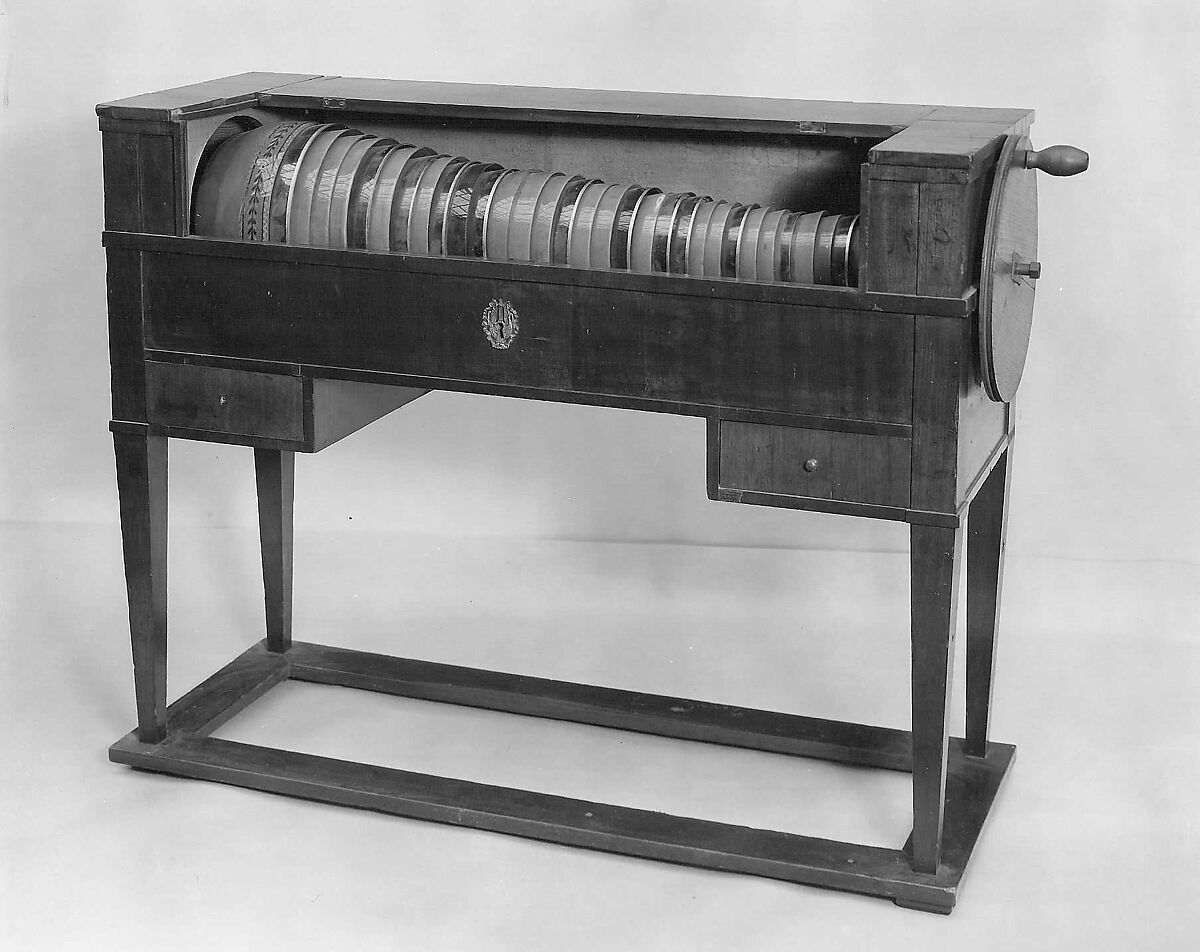
A row of glass bowls sits inside a wooden cabinet, each smaller than the next. The instrument in the Metropolitan Museum of Art’s photograph looks almost like a machine for sorting dishes. It is a glass harmonica: the glass itself makes the music when a player touches its turning surfaces with damp fingers.
The Science Museum Group dates Benjamin Franklin’s invention to 1761. His design developed the familiar idea of making a drinking glass sing, but brought the sounding bowls together on a horizontal iron rod. A foot pedal turned them while the performer played. Pitch depended on the dimensions of each bowl, including its thickness, rather than on how much water had been poured into a glass. The museum’s own example was made by E. Pohl in Bohemia in 1862.
Brussels’ Musical Instruments Museum traces Franklin’s inspiration to a London performance on musical glasses. Its account describes coloured rims that helped distinguish the notes; on the museum’s instrument, made by K. L. Röllig around 1786, gilding took their place. The museum also names the performers who carried this unusual instrument into concert life: Marianne Davies and Marianne Kirchgessner. Mozart dedicated his quintet for glass harmonica, flute, oboe, viola and cello, KV617, to Kirchgessner.
The photograph here shows a different surviving instrument. The Met currently catalogues it as eighteenth-century and possibly German, with wood and glass among its materials. Its maker is not identified in the record. The long case exposes the descending sequence of bowls, with the turning mechanism visible at the right. It belongs to the Crosby Brown Collection of Musical Instruments, accession 89.4.1211; it should not be mistaken for Franklin’s personal instrument.
Start with the Science Museum’s short explanation of how the instrument works, then follow the Brussels record for its performers and another surviving design. The Met’s freely reusable photograph lets you examine the object itself, from the nested glass to the wooden frame below.
Historical instrument, described through three museum records. The pictured example is not identified as Franklin’s own; no recording was reviewed.
Source details & what was checked
- Science Museum Group · Undated web page
Read substantive catalogue description, object details, rights and component listing. No paywall or login encountered. Image licences are noncommercial, so this photograph is not reused.
Glass Harmonica (external source, opens a new tab) · In the source library - Musical Instruments Museum, Brussels · Undated web page
Read entire descriptive text, object identity and material details. No paywall or login encountered. The final paragraph mentions neurotic disorders without graphic detail; our draft does not reproduce an unsupported causal health claim. Newsletter and broader museum links not followed.
Glass harmonica (external source, opens a new tab) · In the source library - The Metropolitan Museum of Art · Undated web page
Read artwork title, attribution, date, materials, dimensions, classification, credit, accession and Public Domain notice. No payment or login gate encountered. Followed object image and museum open-access policy. Related collection branches not certified.
Glass Harmonica (external source, opens a new tab) · In the source library