Added · Daily discovery
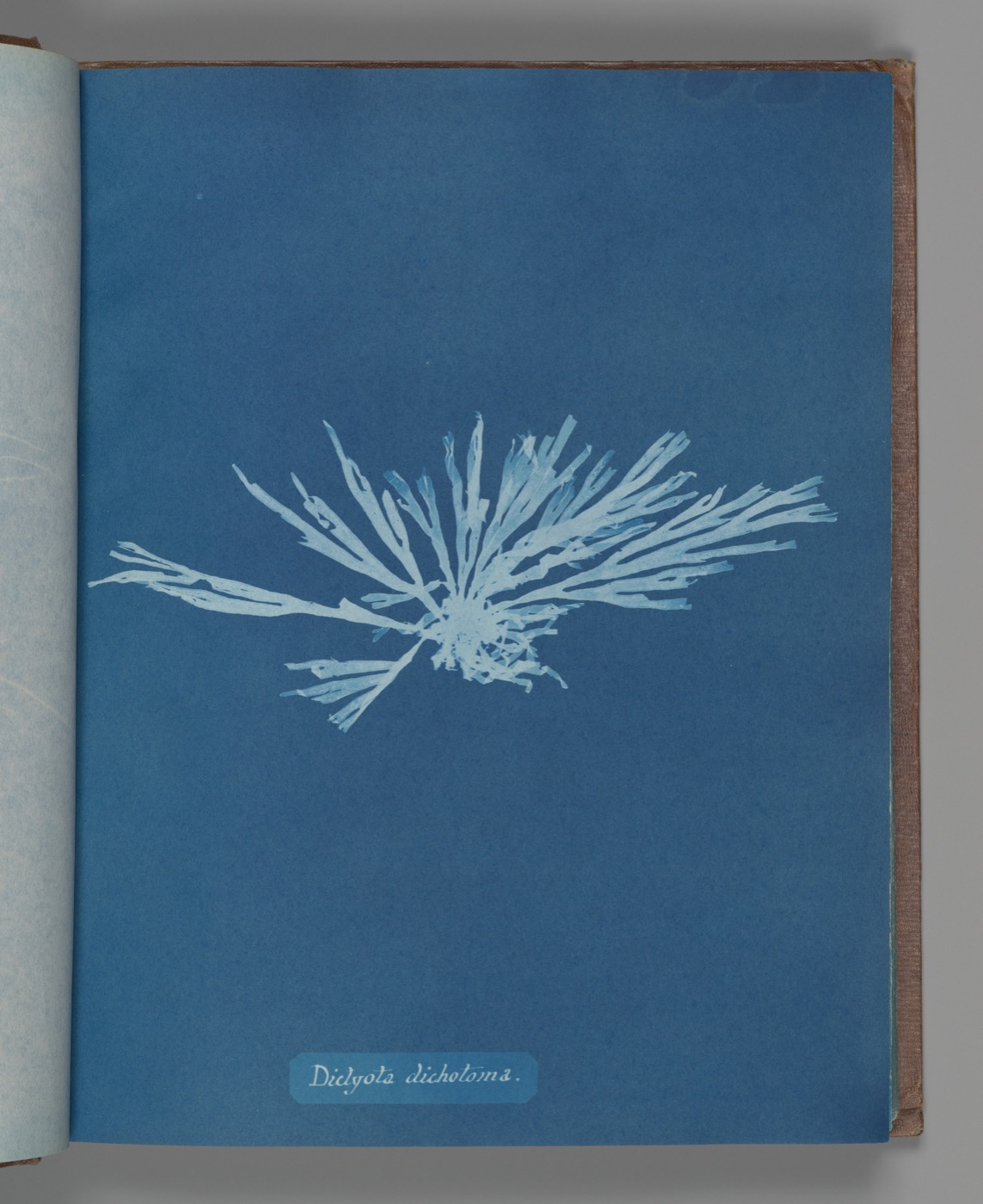
A spray of pale seaweed rests against a deep blue page. Its branches are delicate, but the image was not drawn. Anna Atkins made this kind of botanical photograph by putting the specimen itself against light-sensitive paper. The plant blocked part of the light, leaving a pale impression on a blue ground. A camera was unnecessary.
In 1843, Atkins began issuing Photographs of British Algae: Cyanotype Impressions in parts. The Metropolitan Museum of Art identifies it as the first book both printed and illustrated photographically. Its specimens came from her own collecting and exchanges with other amateur scientists. For their names she followed William Harvey’s 1841 Manual of British Algae, an unillustrated book, and labelled her plates by hand.
The process was new: John Herschel had invented cyanotype in 1842. Atkins used it to record the forms of algae, arranging their strands across individual sheets. The Met explicitly describes a meeting of science and art in these compositions, while noting that artistic expression was not her chief purpose. That connection belongs to the museum’s account of the work; it does not depend on a modern theory about what the images resemble.
The labour behind the blue pages was substantial. The Natural History Museum reports that Atkins made every print herself and that its copies contain 411 plates. Even the book’s text pages and captions reproduce her handwriting photographically. The museum also places her work within a network of scientific education, acquaintances and exchanges, rather than presenting her as an isolated inventor.
Start with the Met’s album record for the project’s history, then its separate record for Dictyota dichotoma, dated around 1853. The reproduced page shows the seaweed spread across the centre, with its name beneath it. The Natural History Museum’s longer account follows Atkins from botanical illustration into photography, explaining how these small, directly printed specimens became an unusually blue book.
Historical work, newly added to the Cabinet. Read the museum accounts below for their full context.
Source details & what was checked
- The Metropolitan Museum of Art; artwork by Anna Atkins · Undated web page
Read complete curatorial description and artwork details on 22 October 2026. Substantive free text, public-domain label and no payment or account gate observed. Album dated 1843–53; page publication date not shown.
Photographs of British Algae: Cyanotype Impressions (external source, opens a new tab) · In the source library - The Metropolitan Museum of Art; artwork by Anna Atkins · Undated web page
Read full object details and public-domain status on 22 October 2026; freely available. Related-object branches not inspected.
Dictyota dichotoma (external source, opens a new tab) · In the source library - Kerry Lotzof / Natural History Museum · Undated web page
Read article body including biography, book-history section and process explanation on 22 October 2026. Free substantial text with no account/paywall. Historical slavery-related family-wealth discussion is factual, non-graphic context, not entertainment. Related links and recipe interactions not followed. No process exercise is reproduced in our draft.
Anna Atkins’s cyanotypes: The first book of photographs (external source, opens a new tab) · In the source library