Odd Almanac

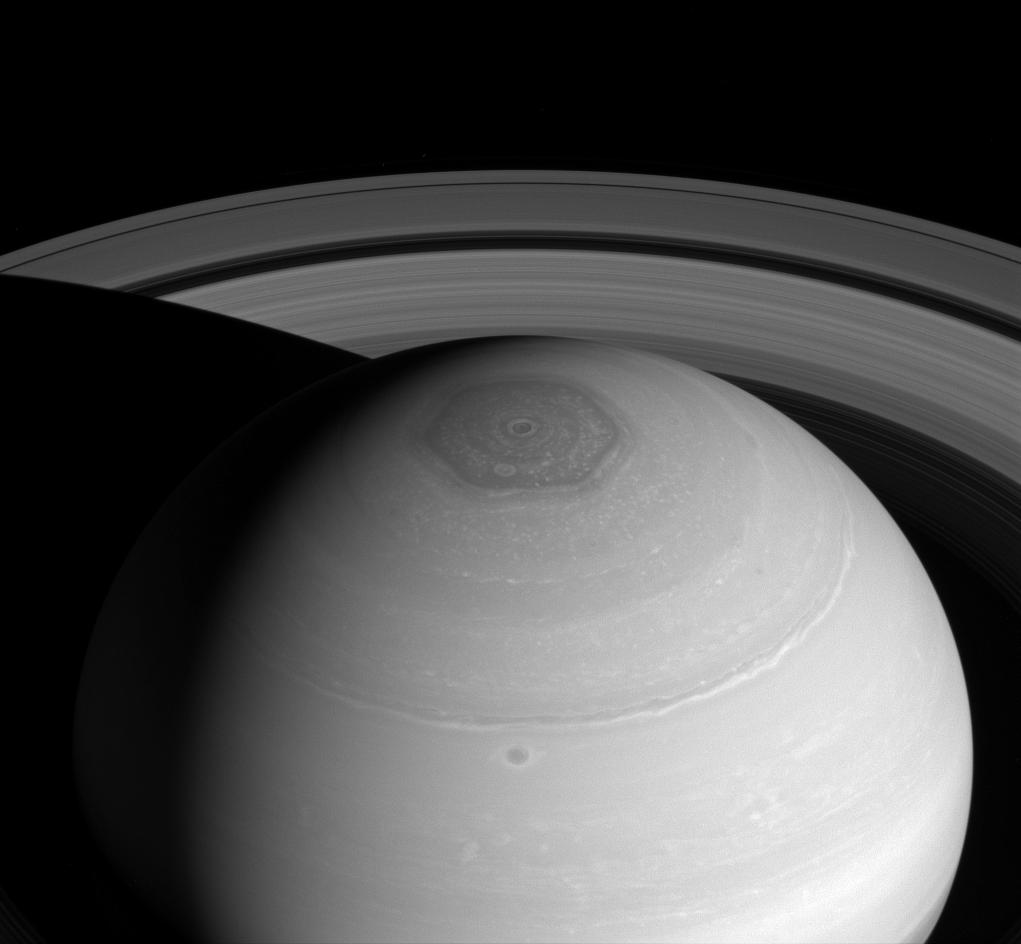
The six-sided jet stream around Saturn’s pole
Cassini’s observations revealed a long-lived atmospheric current with a hexagonal outline, enclosing a polar storm.
The hexagon around Saturn’s north pole is a moving atmospheric feature. Cassini’s 2013 mission report describes a wavy jet stream roughly 30,000 kilometres across, with winds around 322 kilometres per hour and a rotating storm inside it.
Cassini’s cameras followed cloud structures over a ten-hour sequence after sunlight returned to the region in late 2012. Smaller vortices moved around the polar weather system. The resulting images offered more than a striking outline: they showed motion within and around the current.
False-colour processing helped researchers compare the sizes of haze particles inside and outside the jet. The report attributes its possible long-term stability partly to Saturn’s lack of the solid landforms that interrupt weather patterns on Earth; it presents that as an explanation being investigated.
Read the dated mission account for the measurements and processing choices. The geometric shape is observed weather, while its persistence and detailed dynamics are separate scientific questions. No artificial structure is implied by the six-sided outline.
Source details & what was checked
- NASA/JPL-Caltech Cassini mission · 4 December 2013
Read complete main report and photo captions: wavy jet, dimensions, winds,2012ten-hour imaging, false colours/haze distinction and proposed stability explanation. This is dated2013reporting, not a present-day uniqueness claim. Linked movies were not played or certified. Writer read the meaningful exact destination; independent content and responsive destination QA remain pending.
NASA’s Cassini Spacecraft Obtains Best Views of Saturn Hexagon (external source, opens a new tab) · In the source library