
 Odd Almanac
Added · Daily discovery
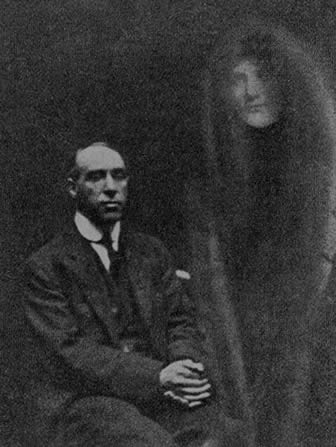
In a photograph from 1922, Harry Price sits with his hands clasped. A pale face hangs above his shoulder. William Hope’s Crewe Circle made portraits in which such figures appeared alongside the sitter. They called the figures spirit extras. Price wanted to know whether Hope would use the plates he supplied.
Price had asked the Imperial Dry Plate Company to mark six glass plates with its lion trademark. The makers used X-rays so the mark would be invisible until the plate was developed. If a picture came out without the lion, Price would have reason to suspect that another plate had been used.
At the London sitting on 24 February, Price later said, he saw Hope make a movement in the darkroom that could have switched the holder for the two plates. His fellow investigator James Seymour was outside the room at that point. One resulting picture was an ordinary portrait. The other had the pale face. Price reported finding no lion on either print and concluded that Hope had deliberately substituted plates.
In November, James Hewat McKenzie, who ran the college that hosted the sitting, challenged Price in the spiritualist weekly Light. He said the wax seals were broken when he inspected the wrappings, and the manufacturer’s label looked as though it had been lifted. The historian Efram Sera-Shriar notes that months had passed and there was no impartial observer to settle when the packaging had been disturbed. The second face is still visible today. The prints alone cannot tell us when any exchange of plates took place.
Source details & what was checked
- Efram Sera-Shriar · 26 November 2022. Science Museum Group Journal, issue 17 (Spring 2022). DOI 10.15180/221707.
Read the introduction and both numbered sections, including plate preparation, sitting and darkroom, the photographic outputs, McKenzie’s chronology and inspection of the wrapping, and the conclusion. Inspected Figures 4, 6, 7 and 9 descriptions and viewed the exact full Figure 6 image. Price’s and McKenzie’s historical claims come from interested parties. Seymour did not see Price’s claimed opportunity for a swap in the darkroom. No impartial witness can settle the later evidence about the wrappers. The case does not establish a paranormal explanation or how every Hope photograph was made.
Photographic plates and spirit fakes: remembering Harry Price’s investigation of William Hope’s spirit photography at its centenary (external source, opens a new tab) · In the source library - Iva Dobreva, National Science and Media Museum · 30 June 2021
Read the historical account of Hope and the Crewe Circle, their album images and the discussion of contemporary sittings. Checked the visible discussion area. Used the post for context and the archive portraits alone. This contextual post is more decisive about how Hope made his work than the journal reconstruction of the 1922 sitting. The draft names the journal and contemporary accounts as the basis for the disputed session. The introductory crystal and wellness examples are not endorsed.
The significance of spiritualism in the work of William Hope (external source, opens a new tab) · In the source library