
 Odd Almanac
Added · Daily discovery
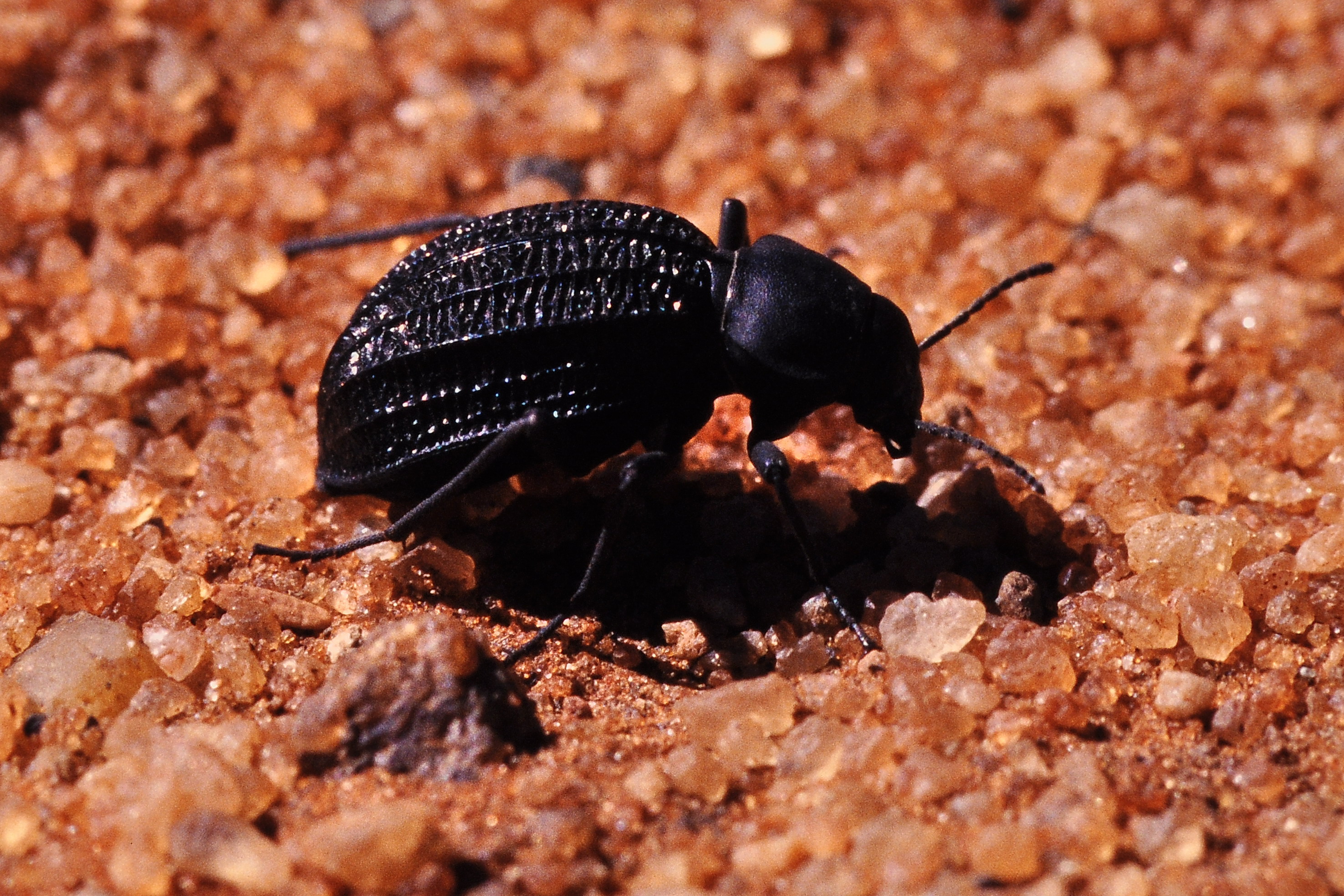
A fog-basking beetle can drink without finding a puddle. The Namib darkling beetle Onymacris unguicularis climbs to a dune ridge and lowers its head. Tiny droplets gather on its wing cases and trickle down towards its mouth.
In a 2010 study, Thomas Nørgaard and Marie Dacke brought the behaviour into a fog chamber. A live beetle in Figure 4 is leaning much less steeply than the term “headstand” suggests. The underside of the body averaged about 23 degrees from horizontal. The other three beetle species kept moving throughout their 20-minute observations.
A separate study had proposed a water-catching mechanism based on a bumpy shell. In 2003, field researchers William J. Hamilton III, John R. Henschel and Mary K. Seely argued that its photograph showed a different beetle from the one named. In the 2010 comparison, the head-down drinker had relatively smooth, grooved wing cases. The authors found the stance and the climb to the ridge more important to its use of fog than the precise texture of its back.
A follow-up chamber experiment compared dead beetles mounted in the drinking position with lengths of dune bushman grass. The grass yielded more water over two hours. Drops ran off the beetle specimens more steadily. The researchers suggested that a steady supply could help a live beetle get a drink even during a short spell on an exposed ridge.
Source details & what was checked
- Thomas Nørgaard and Marie Dacke · 16 July 2010. Frontiers in Zoology 7, article 23.
Read introduction, behavioural methods and results, passive fog collection results, discussion and conclusions. Viewed the actual authors’ Figure 4 PNG, which shows the live beetle and annotated posture angle. The clean anonymous browser URL displayed the relevant article body at all three widths. Fifteen tested O. unguicularis performed the stance in this cold fog chamber. Three comparison species did not. 22.7° is the mean ventral body angle to horizontal. These tests do not establish that surface structure never matters, or that O. unguicularis is the only species in the desert that fog-basks.
Fog-basking behaviour and water collection efficiency in Namib Desert Darkling beetles (external source, opens a new tab) · In the source library - William J. Hamilton III, John R. Henschel and Mary K. Seely · March/April 2003. South African Journal of Science 99, p. 181.
Read the single PDF page, including the complete beetle letter in the lower half, its journal header and author lines. The upper part finishes an unrelated geology reference list. The archive filename contains “Namid”; the printed title correctly says Namib. The authors argued that the photo appeared to depict Physosterna cribipes, a different beetle. They did not dispute the possibility of textured artificial or beetle surfaces collecting fog, and the draft does not resolve the identity of every specimen used by the earlier authors.
Fog collection by Namib Desert beetles (external source, opens a new tab) · In the source library - Thomas Nørgaard, Martin Ebner and Marie Dacke · 3 April 2012. PLOS One 7(4), e34603.
Read the full open article’s materials, results, Figure 3 and Figure 4 descriptions, and discussion. The separate duration trial sampled at 20-minute intervals. Normal Chrome opened the exact article route at all three tested widths. The comparison was between dead beetles mounted head down, grass segments and, for the final amount experiment, wire controls. Beetle runoff was comparatively steady in the chamber. Whether living beetles derive the same benefit in the wild is an inference made by the authors, not a result this comparison established.
Animal or Plant: Which Is the Better Fog Water Collector? (external source, opens a new tab) · In the source library