
 Odd Almanac
Added · Daily discovery
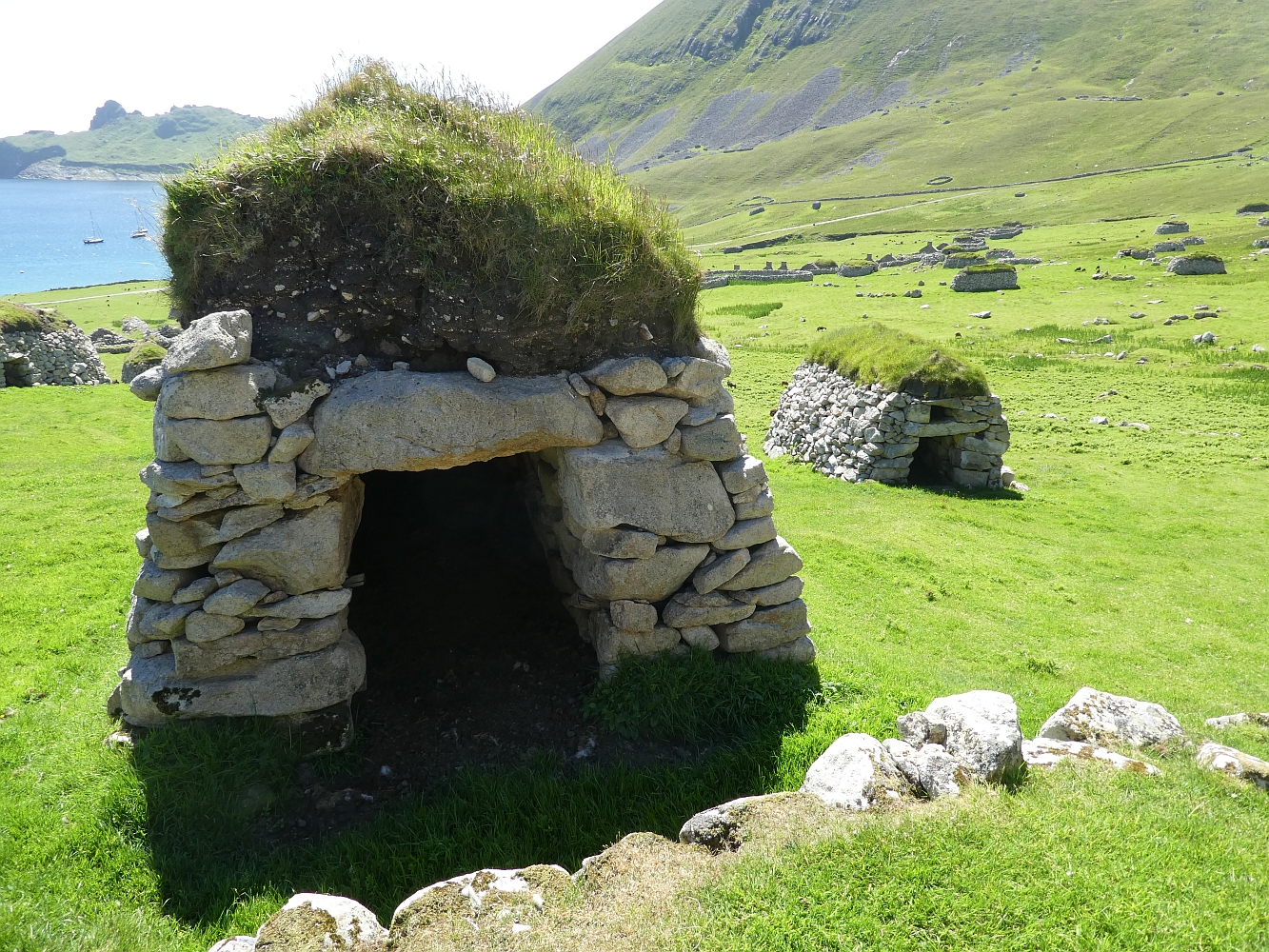
In Rob Farrow’s photograph of Hirta, a thick cap of grass sits above a low stone doorway. A second doorway opens a little farther down the slope, under a cap of its own. These are cleitean, the small dry-stone stores that dot the largest island in Scotland’s St Kilda archipelago.
A single store is called a cleit. Island residents used them to keep fuel, nets and eggs, and to dry seabirds, an important part of their diet. In Nick Aitken’s architectural account, one unusually long cleit held timber washed ashore. Some roofs used large slabs spanning the walls. Others were corbelled, with successive courses of stone projecting inward to close the gap.
The Royal Commission’s 1998 survey puts the archipelago’s total at roughly 1,430. On the sheet marked “The Village”, compare the two views from the east, taken in 1886 and 1986. The survey points to cleitean that appeared in the lower meadows after the earlier photograph. It records one demolished below the Factor’s House and another built farther down the slope.
The turf still takes tending. In 2011, National Trust for Scotland archaeologists Ian McHardy and Carol Knott surveyed 72 Village Bay roofs known to have been repaired since 1996. They found the repairs generally held up better where sheep had stayed off the roofs. The photographs of Cleit 30 show its turf before and after repair.
Source details & what was checked
- Royal Commission on the Ancient and Historical Monuments of Scotland · 1998. RCAHMS Broadsheet 4. ISSN 1358-3441.
Read the publication credit and Building-types and The later photographic evidence. Viewed the rendered second PDF sheet, “The Village”, including the central plan, measured drawings and the matched 1886 and 1986 views.
St Kilda — Settlement and Structures on Hirta (external source, opens a new tab) · In the source library - Nick Aitken. The Stone Trust republication posted by Pamela Hanna. · Autumn 2010 in Stonechat issue 22. Republished 25 April 2022.
Read the full article body, including timber, eggs, nets, roofing variation and dry interiors. Viewed four embedded photographs showing exteriors, stonework and the inside of a roof.
Master Class: The Cleits of St. Kilda (external source, opens a new tab) · In the source library - Ian McHardy and Carol Knott, National Trust for Scotland · December 2011.
Read executive summary and sections 3.4 and 3.8. Visually inspected PDF page 14, printed page 13, including the Cleit 30 before-and-after photographs.
The St Kilda Archaeologists’ Annual Report, 2011 (external source, opens a new tab) · In the source library