
 Odd Almanac
Added · Daily discovery
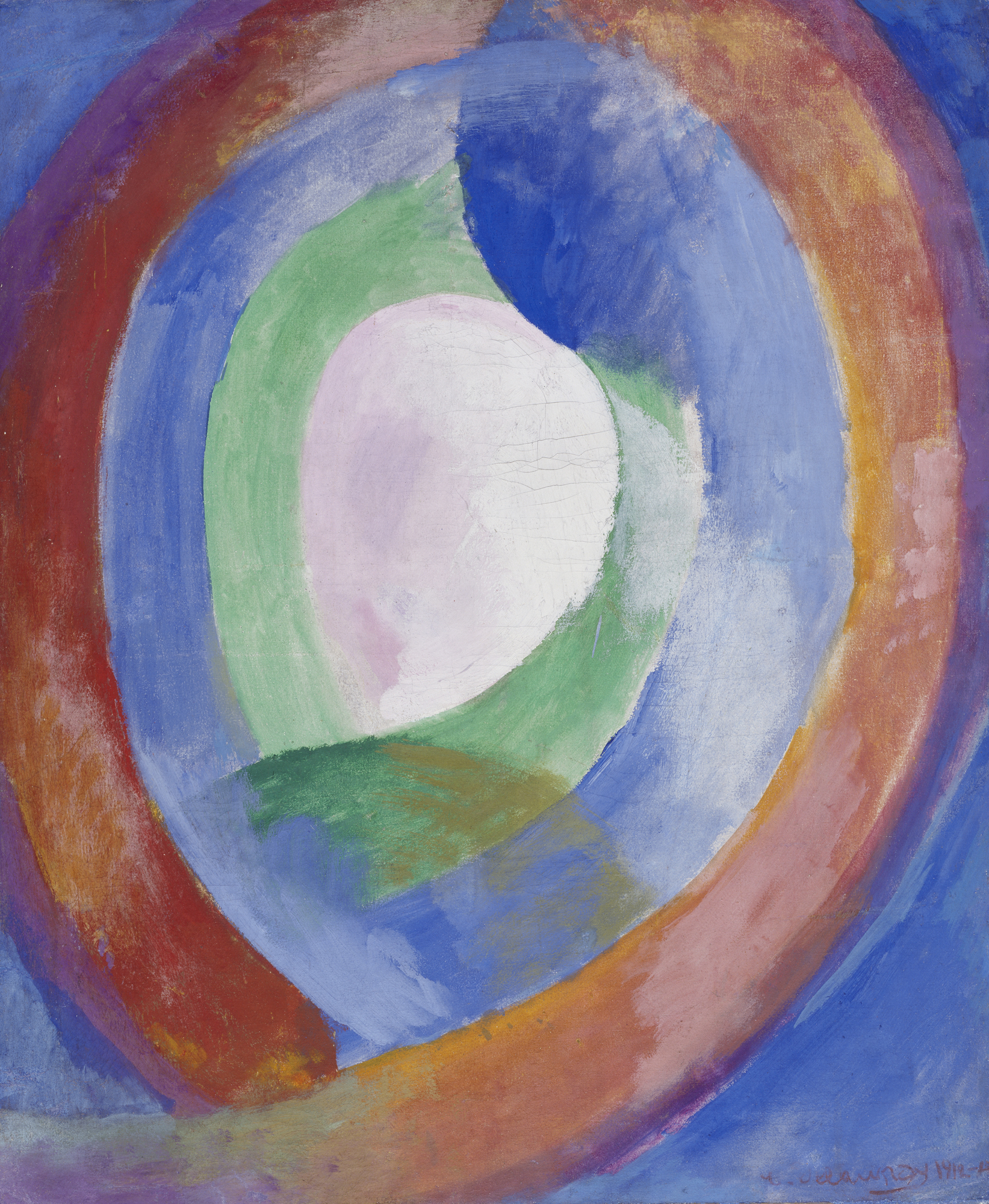
In Robert Delaunay’s Moon No. 1, a pale oval sits inside broad, uneven bands of blue, green, pink and red. Lenbachhaus dates the painting to 1913, although its inscription reads 1912–13. The moon has become an arrangement of coloured surfaces, with no surrounding landscape to fix its scale.
The painting belongs to his Circular Forms series. Lenbachhaus’s catalogue follows the change from the window pictures he had begun the previous year: colour relationships had supplied their structure; now light itself became the subject. Its account distinguishes the quieter circling of the moon pictures from the outward force of the suns. Here, bands widen around the pale centre and overlap in a loose loop below it.
The movement’s musical name came from a poet. Guillaume Apollinaire called Delaunay’s style Orphism, invoking Orpheus, the musician of Greek legend. MoMA describes a Cubist-influenced movement developed around 1912 by Robert and Sonia Delaunay and František Kupka, exploring colour and light through abstraction. Robert’s painting is one particular route into that wider group.
MoMA’s Simultaneous Contrasts: Sun and Moon offers a second version of the idea. Its round canvas is catalogued as 1913, despite the 1912 date on the painting. The museum traces the phrase simultaneous contrasts to Michel-Eugène Chevreul’s 1839 colour treatise. Its discussion of apparent depth and movement concerns the interaction of colours, rather than a depicted landscape.
For comparison, Centre Pompidou’s Sun No. 2 places a coloured disc slightly off-centre. In her catalogue analysis, Brigitte Leal follows the sun paintings into the moon series and then a combined group. Begin with the Munich moon’s full image and German catalogue text; the Paris sun and MoMA’s circular canvas let you compare how differently Delaunay organised the same family of forms.
Source details & what was checked
- Städtische Galerie im Lenbachhaus und Kunstbau München; work text credited to Helmut Friedel and Annegret Hoberg’s Der Blaue Reiter im Lenbachhaus München · 2013 catalogue extract; online record undated
Complete object essay and principal metadata read. Strongest lead: exact painting, detailed visual interpretation and reusable image together. Audio, related artworks and browser controls not exercised. English counterpart timed out twice; the recommended route is the inspected German page.
Formes circulaires, lune no. 1 (external source, opens a new tab) · In the source library - The Museum of Modern Art; MoMA Highlights excerpt, no individual author identified on this record · MoMA Highlights originally 1999, revised 2004; online record undated
Read the full main interpretive excerpt and movement definition, preserving its date distinction. Its image is not selected for reuse. Shop prompts are optional; the text itself was readable without account or payment in this method.
Simultaneous Contrasts: Sun and Moon (external source, opens a new tab) · In the source library - Brigitte Leal, catalogue analysis; Centre Pompidou online object record · 2007 catalogue extract; object dated 1912–1913; online record undated
Main analysis read, with named curator and catalogue date retained. Supports the off-centre disc and series relationship. Neither video nor linked commercial image-licensing service was used.
Formes circulaires, Soleil n° 2 (external source, opens a new tab) · In the source library