
 Odd Almanac
Edition · Daily discovery
Backfilled edition · First published .
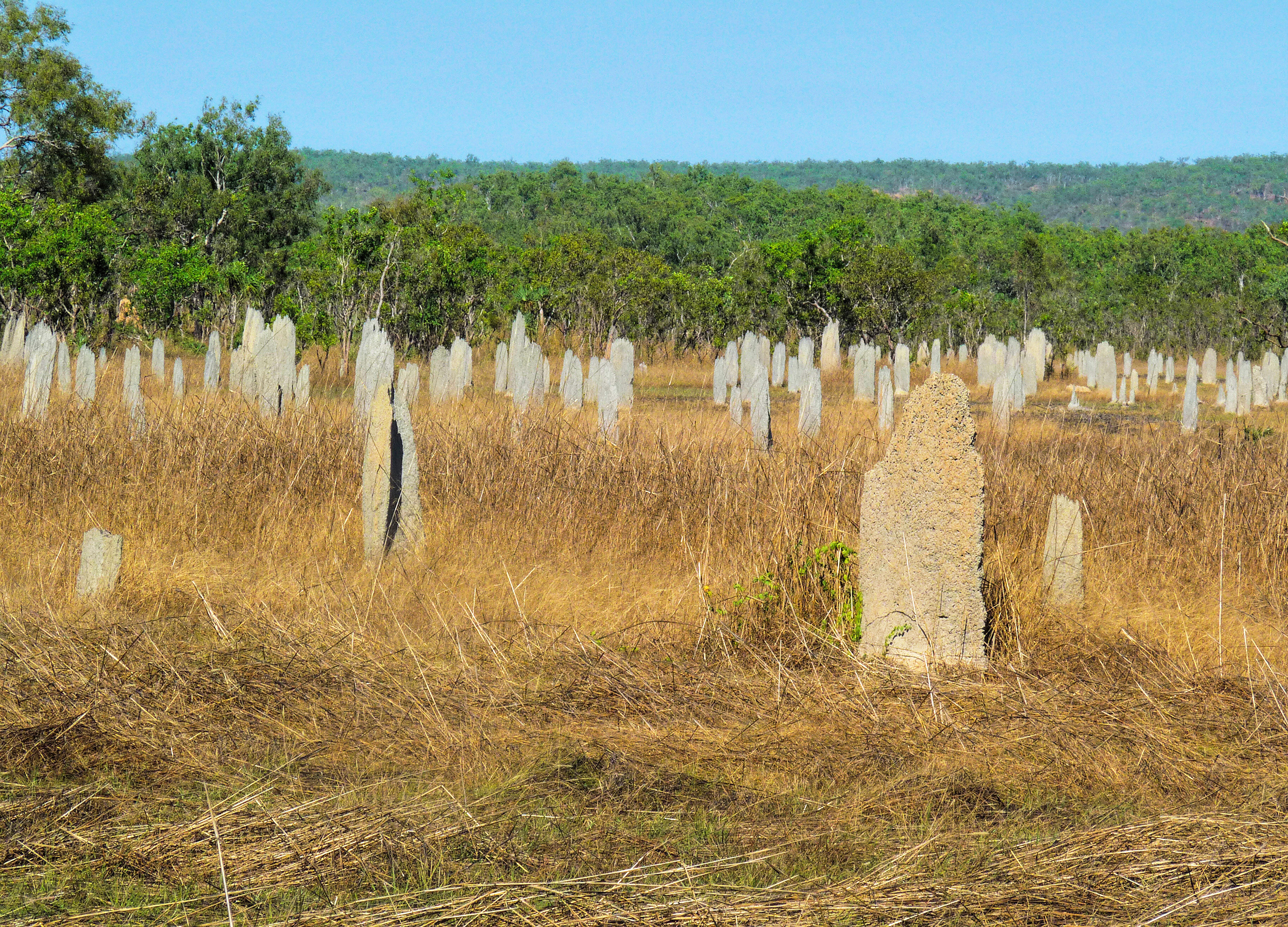
A field of termite mounds in northern Australia can seem to share a common alignment. The thin edges run roughly north to south, while the broad faces look east and west. These are the homes of the grass-eating termite Amitermes meridionalis, often called magnetic or compass termites.
The National Archives of Australia introduces the structures through a 1950 photograph. A person stands among nine towers, making their scale easier to read. Its explanation connects the alignment with morning and evening warming and reduced midday exposure. Wind can alter the direction; the field pattern need not be perfectly uniform.
Seasonal flooding gives height a separate importance. The Archives notes that low sections can be inundated for weeks, leaving the above-ground home especially important. Its account reports temperature differences of up to eight degrees Celsius between sunlit and shaded surfaces.
The Northern Territory’s two-page Nature Notes places these structures among very different termite homes. Tall cathedral mounds belong to Nasutitermes triodiae; other species build in trees or remain underground. The guide describes termites breaking down dead plant material with help from microorganisms in their guts. Their mounds store nutrients which return to the soil as an abandoned mound breaks down. Their excavations in trees also provide habitat for other animals, including birds, bats and reptiles.
The word magnetic needs care. The Archives describes use of Earth’s magnetic field as a speculation in its account. That possible directional cue is a separate question from the temperature advantage of an alignment. Seeing the structures does not establish how the insects choose their direction.
The 2010 archival learning resource calls magnetic-field guidance a speculation; this article does not turn that historical account into a current consensus claim. The photograph is a separate 2009 contextual view, not the archival 1950 image.
Source details & what was checked
- Education Services Australia Limited and National Archives of Australia · 2010 learning-resource text; photograph 1950
Complete archival learning-resource main body and educational-value notes independently read in the actual browser on 5 November 2026 at desktop, 390px and 320px. The learning text is dated 2010 and interprets a 1950 photograph. It explicitly labels geomagnetic guidance as speculation; no primary orientation or magnetoreception experiment was independently read, and this historical account is not presented as a 2026 consensus review. Minor narrow-screen overflow requires ordinary panning on the source site. Reading route independently rechecked on 6 November 2026 at desktop, 390px and 320px; the original content-reading and interpretation limits remain.
Magnetic termite structures in the Northern Territory (external source, opens a new tab) · In the source library - Stuart Traynor and Dean McAdam; illustrations Bob Whiteford; Northern Territory Government · Undated two-page government nature guide
Both pages independently read in the ordinary native PDF reader on 5 November 2026, including authors, mound-type distinctions, nutrition and tree-hollow habitats. The published legacy NT URL redirects normally to the same freely readable guide at https://nt.gov.au/_media/docs/parks/parks-resources-for-schools/nature-notes/invertibrates/termite-homes.pdf. Desktop, 390px and 320px native reading/panning exercised without login, payment or a required app. Further-reading book mentions are not recommended purchases. Browser widths were tested, not physical devices. Reading route independently rechecked on 6 November 2026 at desktop, 390px and 320px; the original content-reading and interpretation limits remain.
Nature Notes — Termite homes / Termites: Nature’s recycling agents (external source, opens a new tab) · In the source library