
 Odd Almanac
Added · Daily discovery
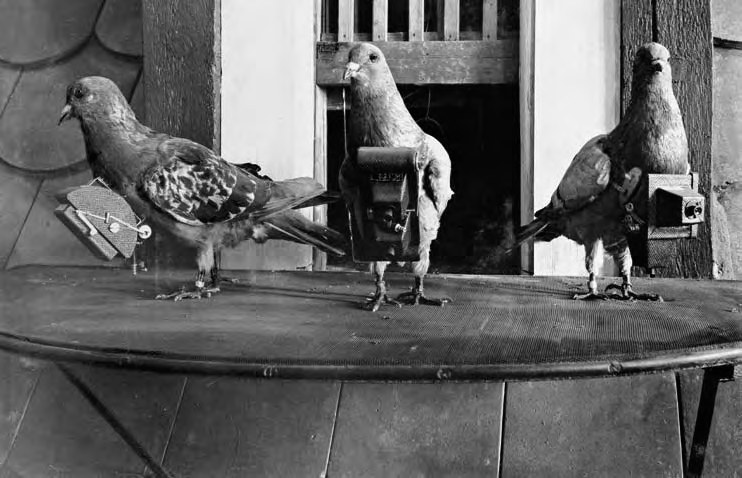
Julius Neubronner’s pigeons carried more than messages. The pharmacist from Kronberg in Germany developed miniature cameras that could be fastened to the birds, with an automatic release to take photographs during flight. The surviving equipment and photographs document an unusual branch of early aerial photography.
His family already used homing pigeons to bring prescriptions to the pharmacy. The Deutsches Technikmuseum’s online exhibition recounts how one bird disappeared for four weeks, prompting Neubronner to wonder where it had been. A camera offered a possible record of the journey. A timed shutter made the exposure without a person behind a viewfinder.
The Berlin museum dates his patent application to 1907 and its acceptance to 2 December 1908, after he submitted authenticated photographs. It also describes his 1909 demonstration in Dresden: the birds returned, their pictures were developed on site, and the results became postcards. These are the museum’s historical account and dates, rather than a claim that we have examined the original patent.
There was more than one camera design. The Swiss Camera Museum describes the Doppel-Sport, developed around 1910, as a panoramic device with a rotating lens. Its delayed trigger produced a single image on a curved negative measuring 3 by 8 centimetres. The photograph here shows three birds wearing different camera arrangements; its Commons record dates the scene to 1909, at an exhibition in Dresden or Frankfurt.
The Swiss museum follows the idea into the 1930s, when watchmaking-parts manufacturer Christian Adrian Michel developed a camera using 16 mm film. A timing mechanism controlled the delay, film advance and interval between photographs. Its account says that this later camera never became a commercial success. The two museum reading routes offer an English overview and a more detailed German exhibition, with historic objects and aerial images.
The Swiss overview gives an earlier patent date; the chronology here is explicitly attributed to the Berlin museum. Its detailed online exhibition is in German. No physical museum visit or original patent inspection is claimed.
Source details & what was checked
- Isabel Wanger and Bettina Gries (editorial); Antje Stritzke (photo editorial) / Deutsches Technikmuseum · Undated online exhibition; objects dated 1907–1920s
Complete exhibition text and captions read through the web reader on 4 November 2026, including family pigeon post, the missing bird account, timed release, patent chronology, Dresden postcards and subsequent history. Editorial credits read at the end. This is the museum’s retrospective in German, not an inspection of the patent or original negatives. Warfare references are historical and non-graphic; the entry focuses on photographic apparatus and exhibition postcards. No endorsement of camera use on animals or practical instructions. Independent ordinary-browser destination and responsive review is recorded separately.
Julius Neubronner und seine fliegenden Fotografen (external source, opens a new tab) · In the source library - Swiss Camera Museum, Vevey (institutional text; no individual byline) · Undated museum page; cameras circa 1910 and 1930s
Complete English museum explanation and image caption read through the web reader on 4 November 2026. Describes Neubronner’s carrier-pigeon cameras, rotating-lens Doppel-Sport and 3×8 cm negative, then Christian Adrian Michel’s 1930s camera, 16 mm film, timing and limited commercial outcome. Its 1903 patent date conflicts with the Berlin museum’s 1907 application/1908 grant; the entry explicitly attributes its chronology to Berlin and does not silently combine these dates. The illustrated Swiss prototype is circa 1935, not the 1909 photograph reused here. Wider Collections, ticket and webcam routes are not recommended or cleared.
Photographer pigeons… (external source, opens a new tab) · In the source library