
 Odd Almanac
Added · Daily discovery
Leopold and Rudolf Blaschka made jellyfish, anemones and other invertebrates out of glass for museums and universities. These father-and-son glassworkers supplied scientific teaching models from their studio in Dresden. Their marine animals came before the botanical models they made for Harvard’s Glass Flowers collection.
Harvard’s Museum of Comparative Zoology describes approximately 430 models in its collection, purchased in the 1870s and 1880s. Many arrived through the North American distributor Henry Ward. His 1878 catalogue offered 630 invertebrate models, priced from 30 cents to $6.50. They were objects that institutions could order for teaching and comparison.
The materials were more varied than the name suggests. The museum describes colourless and coloured glass, water-soluble pigments, glue, occasional wire and, in some models, organic materials such as stretched animal hide. Around 1900, its models were moved from cardboard trays onto white plaster plates, held with wire.
Alvin Powell’s 3 July 2014 Harvard Gazette account follows conservator Elizabeth Brill’s eight-year effort to clean and reassemble that collection. Much of the glass had survived; old glue had failed, leaving components separated. Curators had kept the pieces. Some models contained more than a hundred parts, making restoration a patient exercise in recovering their structure.
Powell reports that the project began as collection care, rather than a plan for an exhibition. The restored animals became the basis of Sea Creatures in Glass in 2014. This is a dated account of that work, rather than a fresh inspection of the gallery.
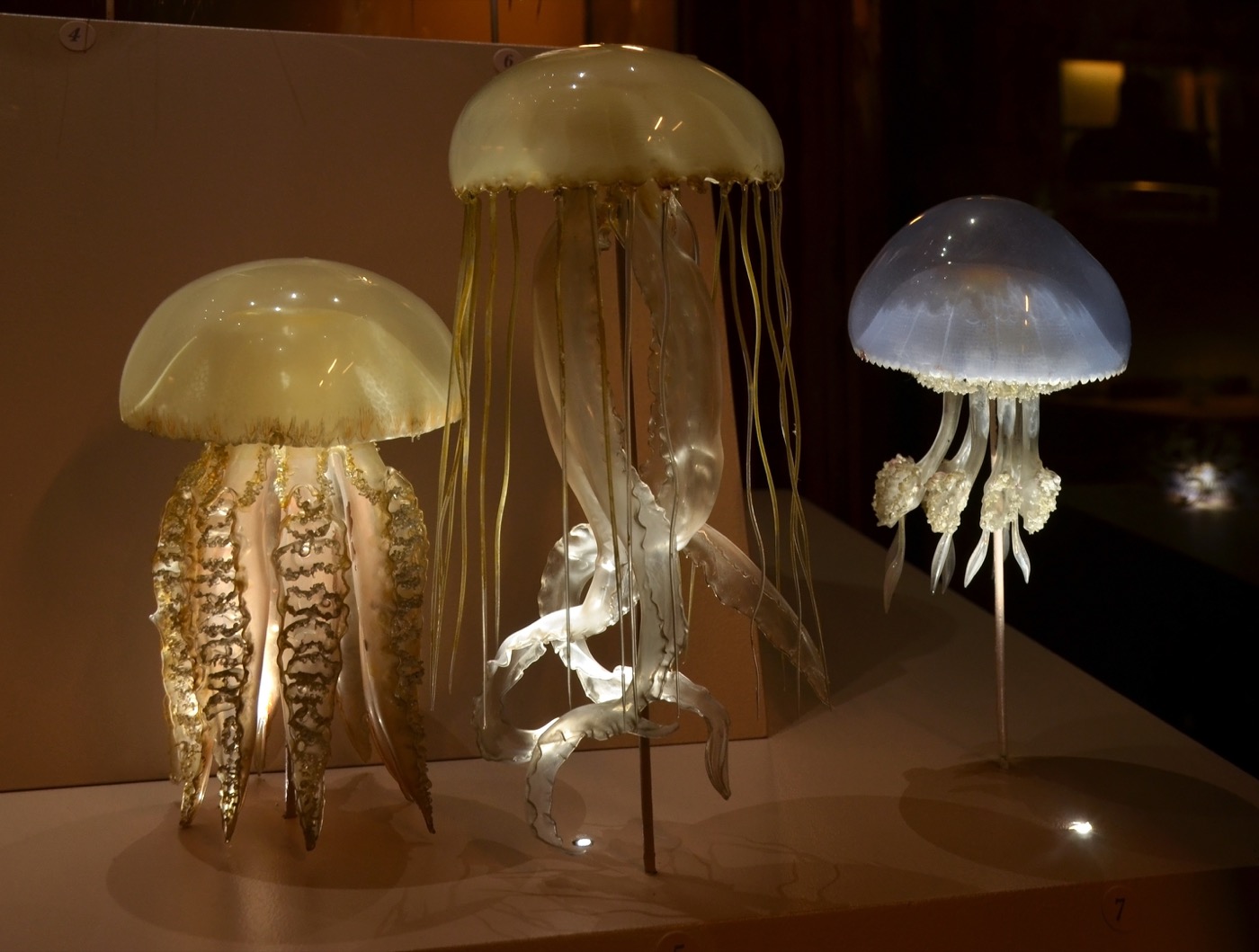
The photograph here records a different collection: Blaschka jellyfish models at Geneva’s natural history museum, photographed by Vassil on 22 October 2014. These are glass representations of animals, not preserved or living jellyfish.
Scientific teaching models and a dated restoration account. The Geneva photograph shows a different collection from the Harvard objects discussed in the text.
Source details & what was checked
- Museum of Comparative Zoology, Harvard University · Undated collection history
Complete collection and History text read, including 1870s/1880s acquisitions, Henry Ward’s 1878 catalogue, materials, teaching/comparison use, circa 1900 mounting, glue deterioration and archival repair. History tab selected and meaningful reading checked on desktop and phones. Undated collection description and dated 2014 exhibition history kept distinct. Database, 3D models, video and book branches not reviewed.
Blaschka Glass Invertebrates (external source, opens a new tab) · In the source library - Alvin Powell / Harvard Gazette · 3 July 2014
Complete main 2014 article and four model-gallery slides read. Retains Elizabeth Brill’s eight-year restoration, glue failure rather than widespread broken glass, and collection-care purpose as dated institutional reporting. No physical museum visit, restoration test, linked video viewing or present-day exhibition inspection claimed.
Undersea life, clear as glass (external source, opens a new tab) · In the source library