
 Odd Almanac
Added · Daily discovery
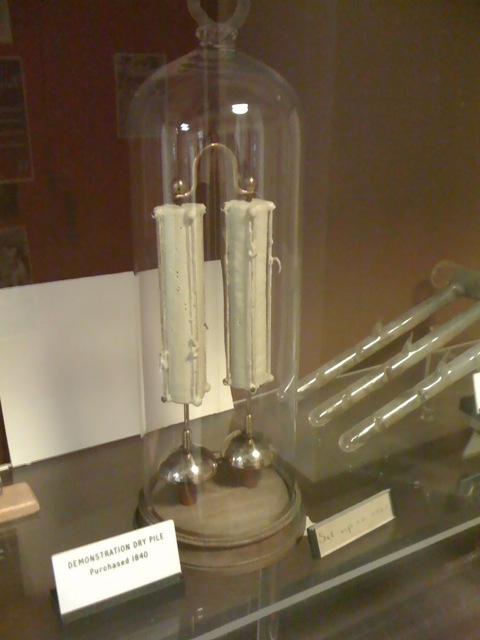
Oxford’s Department of Physics archive describes a small electrical apparatus with Robert Walker’s handwritten label: “Set up in 1840”. A later note suggests it might have been constructed about fifteen years earlier. The label dates its installation, rather than securely dating its manufacture.
Two voltaic dry piles, an early form of battery, connect to a pair of bells. A metal sphere about four millimetres across hangs between them. It is attracted alternately to each bell, carrying electrical charge from one side to the other. The department describes roughly two oscillations per second and estimates about ten billion rings. Those figures belong to its undated historical exhibit, rather than a new measurement.
The piles have an insulating sulphur coating, while their internal construction remains uncertain. Oxford compares them with similar nineteenth-century devices when suggesting what might be inside. A proposed recipe is different from an examined interior.
A second route into the story is a letter held by the Institution of Engineering and Technology. In 1914, physicist Robert B Clifton recalled carrying the instrument from the Museum to the Clarendon Laboratory in 1870. He reported that it had been working before the move, restarted when he put it down, and had remained untouched since October 1870.
The IET’s 2015 account identifies the correspondence and explains how it was found inside a book about dry piles. It supplies a dated witness account alongside Oxford’s description of the mechanism. Both institutions distinguish a remarkably enduring battery-powered device from perpetual motion.
Historical exhibit and archival correspondence. No current live observation, updated ring count, audio or video inspection is claimed.
Source details & what was checked
- University of Oxford, Department of Physics · Undated departmental archive
Complete departmental exhibit text read, including the handwritten 1840 label, mechanism, approximate oscillation/ring estimates, uncertain internal construction and warning about perpetual-motion descriptions. Undated archive estimates are retained as historical statements; no current operation, new count or full physical examination is claimed. The older page has a fixed-width layout; phone readers need horizontal panning.
Exhibit 1 · The Clarendon Dry Pile (external source, opens a new tab) · In the source library - IET Archives / Institution of Engineering and Technology · 12 August 2015
Complete 2015 first-party archival account read, including its transcriptions and catalogue/provenance discussion of Robert B Clifton’s 1914 letter and postcard. Its reported 1870 move is historical testimony, not a new observation of the apparatus. The full 1812 book and linked museum/exhibit routes were not reviewed.
Perpetual Motion in the IET Archives (external source, opens a new tab) · In the source library