
 Odd Almanac
Added · Daily discovery
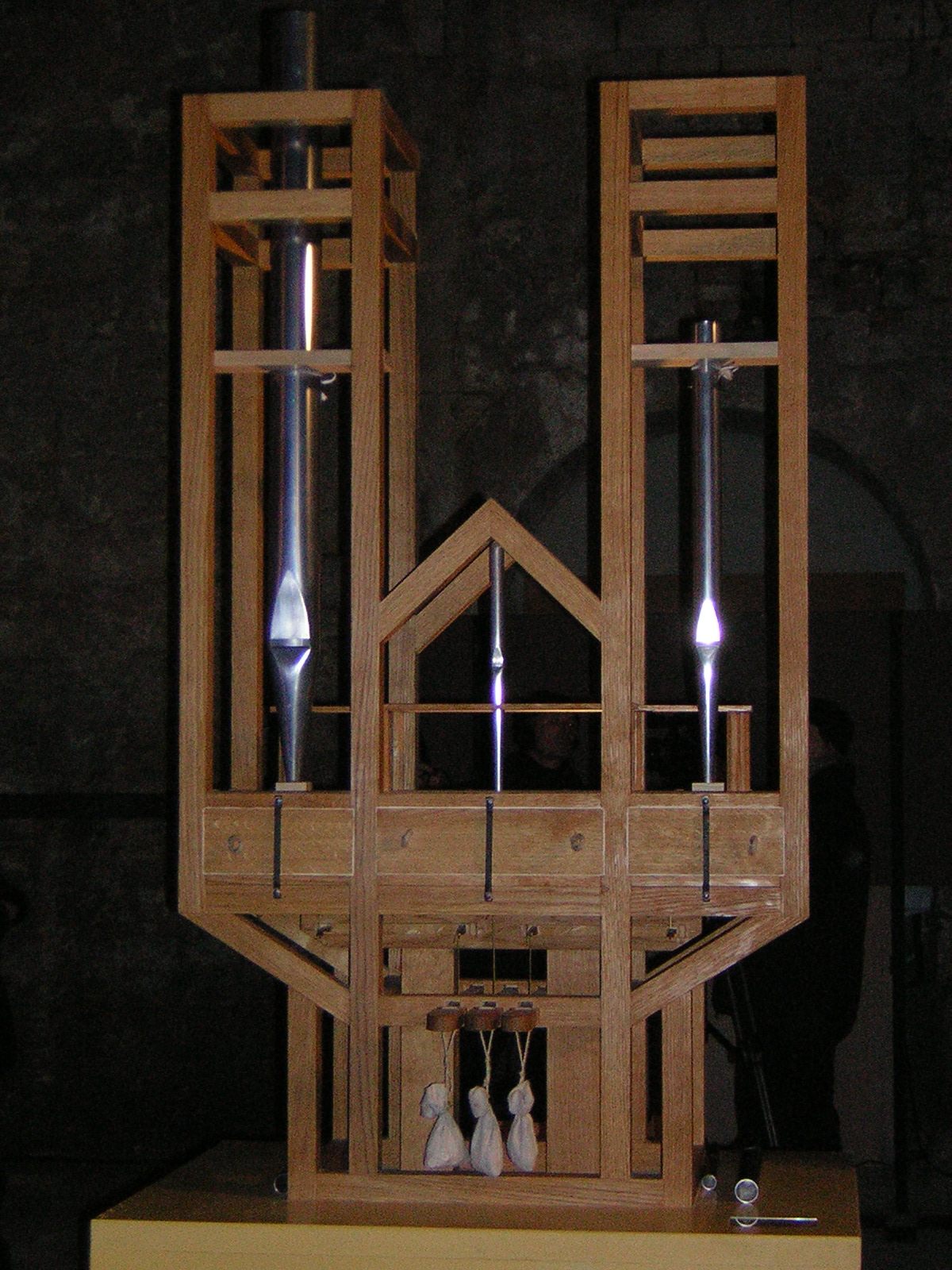
Three visible metal pipes rise through a spare wooden frame, with small bags hanging beneath them. This early photograph shows the special organ in St. Burchardi, a former monastery church in Halberstadt, Germany. The instrument belongs to a performance whose planned duration is 639 years.
The work is John Cage’s ORGAN²/ASLSP: “as slow as possible.” A brochure published through the city explains that Cage first wrote ASLSP for piano in 1985, then adapted it for organ in 1987 at the suggestion of organist Gerd Zacher. The centuries-long duration is the Halberstadt project’s realization of the work. The brochure also describes an earlier organ performance lasting 29 minutes.
Why 639? The brochure connects that number to an organ built in Halberstadt’s cathedral in 1361. Subtracting that year from the millennium year 2000 gives 639. The project turned that historical interval into a future span for its own performance, rather than treating a single human lifetime as the limit.
The project’s published timeline begins on 5 September 2001 with bellows and wind, but no sounding pipes. Its first change, on 5 February 2003, introduced three notes. Later entries show how far apart musical events can be: a change in October 2013 was followed by the next one in September 2020. Listening to a portion therefore need not include a change of notes.
The organizers describe a planned ending on 4 September 2640, while openly asking what happens if the bellows fail, who the musicians are, and whether an unattended performance is still a concert. Their account says the private foundation is led by volunteers and depends mainly on donations. The distant finish remains a project to sustain, rather than an event anyone can already guarantee.
An attributed account of a continuing performance project. The photograph shows an earlier pipe arrangement; it does not document today’s sound. Source text and timetable reviewed; audio, video and the musical score were not reviewed.
Source details & what was checked
- John-Cage-Orgel-Stiftung Halberstadt · Undated project account; checked 29 October 2026
Complete German project text and published sound-change table read. Dates distinguish the 2001 start with bellows/wind, first notes in February 2003 and planned September 2640 ending. Organizers’ questions and volunteer/donation account remain attributed. Audio links, video, score and wider shop not reviewed.
John-Cage-Orgel-Kunst-Projekt: project and sound-change timeline (external source, opens a new tab) · In the source library - John-Cage-Orgel-Stiftung Halberstadt / city of Halberstadt · Undated historical brochure
Both pages of the free municipal-hosted brochure read as extracted PDF text, including English history and German account. Supports piano 1985, organ 1987/Gerd Zacher, an earlier 29-minute performance and the 1361-to-2000 arithmetic behind 639 years. Historic opening hours, statistics and obsolete links are not current visitor advice. PDF layout not newly visually reviewed by writer.
John-Cage-Organ-Project in Halberstadt: bilingual brochure (external source, opens a new tab) · In the source library