
 Odd Almanac
Edition · Daily discovery
Backfilled edition · First published .
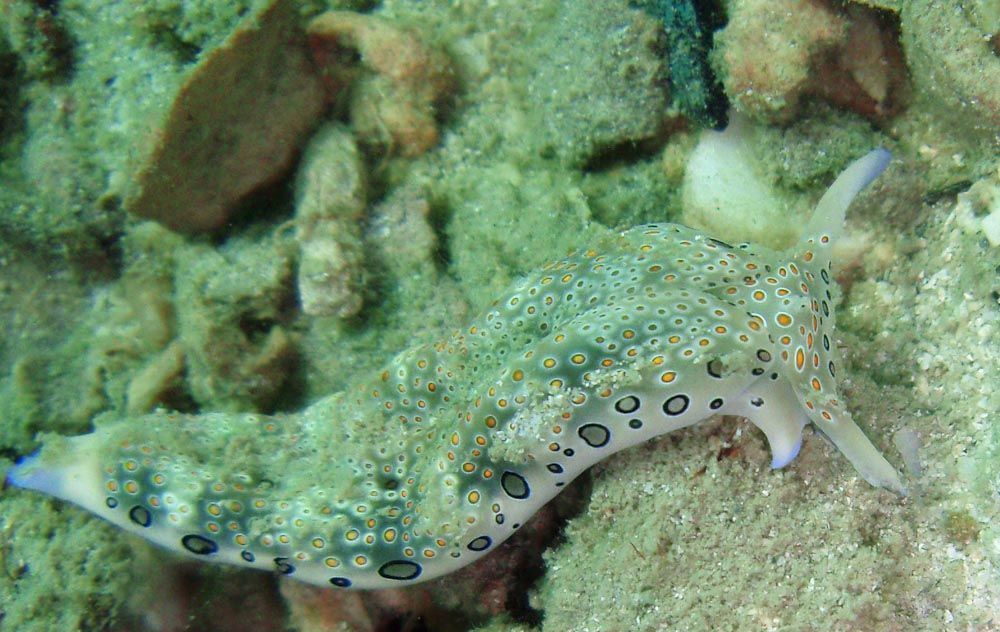
A sea slug can digest algae while keeping some of their working machinery. In a process called kleptoplasty, chloroplasts taken from food remain inside the animal’s intestinal cells. These are the structures that carry out photosynthesis. In some sea slugs they continue working for months, long after the rest of the meal has disappeared.
Taro Maeda and colleagues investigated Plakobranchus ocellatus in a 2021 eLife paper. They studied the lineage they call type black, or PoB: the familiar species name covers a group of closely related animals. Their measurements included oxygen production, photosynthetic efficiency and survival under different lighting conditions. The retained chloroplasts remained active after more than three months without feeding. Slugs given alternating light and darkness lived longer, on average, than those kept continuously dark.
The genetic result addressed a different puzzle. Chloroplasts normally depend on proteins whose genes sit in the algal nucleus. A proposed explanation was that slugs had acquired the necessary algal genes. As Science Japan explains, the team searched the slug genome, raw sequencing data and gene-expression data without finding evidence for the photosynthesis-related transfers they were looking for. That result did not mean the entire maintenance mechanism had been solved.
Keio University’s project page places the work within research on traits acquired through retained organelles and proteins. For this animal, the useful distinction is between keeping a chloroplast and inheriting an alga’s nuclear instructions. The open paper supplies the experimental details; the Science Japan account explains why obtaining good-quality slug DNA mattered to the investigation.
Source limitations and contextual photograph distinctions remain as recorded.
Source details & what was checked
- Taro Maeda, Shunichi Takahashi, Takao Yoshida, Shigeru Shimamura, Yoshihiro Takaki, Yukiko Nagai, Atsushi Toyoda, Yutaka Suzuki, Asuka Arimoto, Hisaki Ishii, Nori Satoh, Tomoaki Nishiyama, Mitsuyasu Hasebe, Tadashi Maruyama, Jun Minagawa, Junichi Obokata and Shuji Shigenobu ·
Meaningful selective full-text reading: abstract, introduction, Figure1 context, Results on light/oxygen/survival, genome-search discussion and Figure5 candidate gene discussion. Supplementary raw data and all methods not independently reanalysed. Free article body and CC BY notice visible; optional PMC account controls are not required for reading. Reading route independently rechecked on 6 November 2026 at desktop, 390px and 320px; the original content-reading and interpretation limits remain.
Chloroplast acquisition without the gene transfer in kleptoplastic sea slugs, Plakobranchus ocellatus (external source, opens a new tab) · In the source library - Science Japan / Japan Science and Technology Agency; translated with permission from The Science News Ltd.; no individual byline shown ·
Complete main text read, including genotype-search account and explicit statement that the molecular maintenance mechanism remained unknown. This is an institutional news explanation, not a second experiment. Photographs on this page explicitly prohibit unauthorised reproduction and are not selected for reuse. Reading route independently rechecked on 6 November 2026 at desktop, 390px and 320px; the original content-reading and interpretation limits remain.
Genome sequencing of Plakobranchus ocellatus: An animal that conducts photosynthesis (external source, opens a new tab) · In the source library - Institute for Advanced Biosciences, Keio University; Taro Maeda project listing · Undated; inspected 4 November 2026
Complete short project description and publication list read, including link to the 2021 eLife paper. Project framing, not independent confirmation of the experiment. Reading route independently rechecked on 6 November 2026 at desktop, 390px and 320px; the original content-reading and interpretation limits remain.
Kleptobiolgy Project (external source, opens a new tab) · In the source library