
 Odd Almanac
Added · Daily discovery
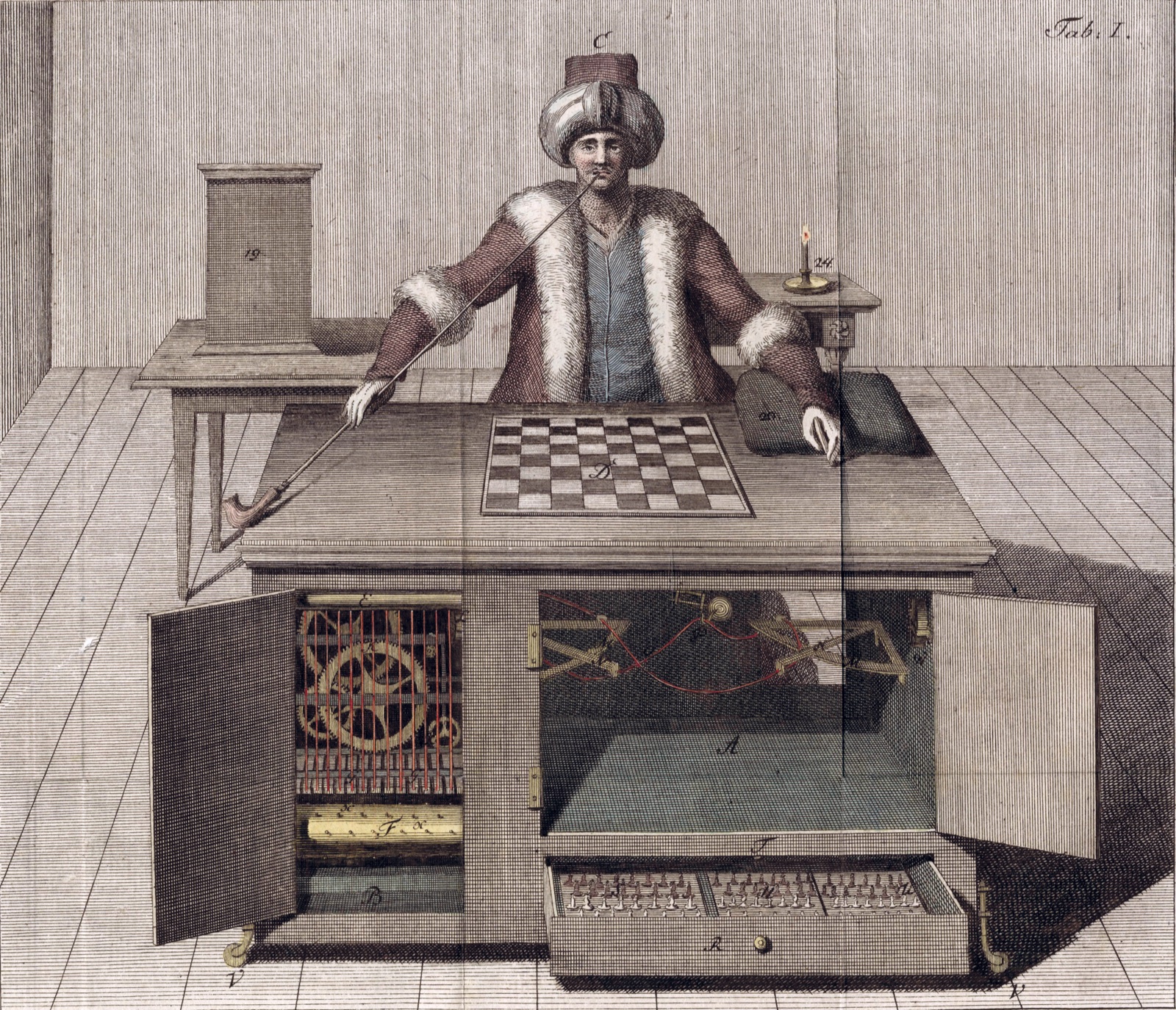
An eighteenth-century engraving shows a figure in a turban seated at a chessboard. Below it, open cabinet doors display wheels and other machinery; a drawer holds chess pieces. The apparatus belonged to Wolfgang von Kempelen’s celebrated chess-playing attraction, known as the Turk. Its performance appeared to offer a mechanical opponent across the board.
The Computer History Museum’s catalogue supplies the essential explanation: a human chess player was hidden inside. The machine’s apparent playing strength came from that person. The cabinet and figure were part of an elaborate performance, rather than a machine independently deciding which move to make.
A second museum record preserves a Philadelphia playbill dated 1834. Its catalogue account says Johann Nepomuk Maelzel bought the attraction from Kempelen’s son around 1807 and took it to America in 1826. It names New York, Boston and Philadelphia among the cities where audiences watched it play. The surviving advertisement gives that travelling spectacle a particular place and date.
The picture reproduced here comes from Joseph Racknitz’s 1789 book. Its Wikimedia Commons description identifies it as part of an attempt to explain the illusion through reconstructions. It is a historical illustration, not a photograph of a surviving original or proof that every pictured component matches Kempelen’s mechanism.
There is also a later object to explore. The Heinz Nixdorf MuseumsForum describes a reconstruction that played its first game on 25 March 2004. The museum presents the original attraction as both a trick and a technical accomplishment, and places its reconstruction alongside historic chess computers.
Begin with the Computer History Museum’s short explanation, follow its playbill record for the American tour, then visit the HNF account for the modern reconstruction. These are distinct records of an illusion, its publicity and its later recreation.
Museum accounts give different early dates: CHM says 1770; HNF dates the court demonstration to 1769. Neither date is silently treated as a settled common chronology.
Source details & what was checked
- Computer History Museum; engraving attributed to Joseph Racknitz · 1789 engraving; undated catalogue account
Read complete free catalogue description and object metadata. Explicitly identifies concealed human chess player. No wider collection clearance claimed.
Engraving of The Turk (external source, opens a new tab) · In the source library - Maezel’s Exhibition, Masonic Hall / Computer History Museum catalogue · 1834 playbill; undated catalogue account
Read full free catalogue text: Philadelphia 1834 playbill, purchase around 1807, arrival in America in 1826 and touring cities. Linked full-resolution playbill/PDF not read; catalogue text is the offered reading scope.
Playbill for the Automaton Chess Player (external source, opens a new tab) · In the source library - Heinz Nixdorf MuseumsForum · Undated account of the 2004 reconstruction
Read complete free museum account of reconstruction, 25 March 2004 first game and mechanical illusion. Do not repeat disputed celebrity-match anecdotes, first-ever claims or secret-revelation chronology. Linked video and wider museum catalogue not reviewed.
The Chess Turk has been brought back to life (external source, opens a new tab) · In the source library