
 Odd Almanac
Added · Daily discovery
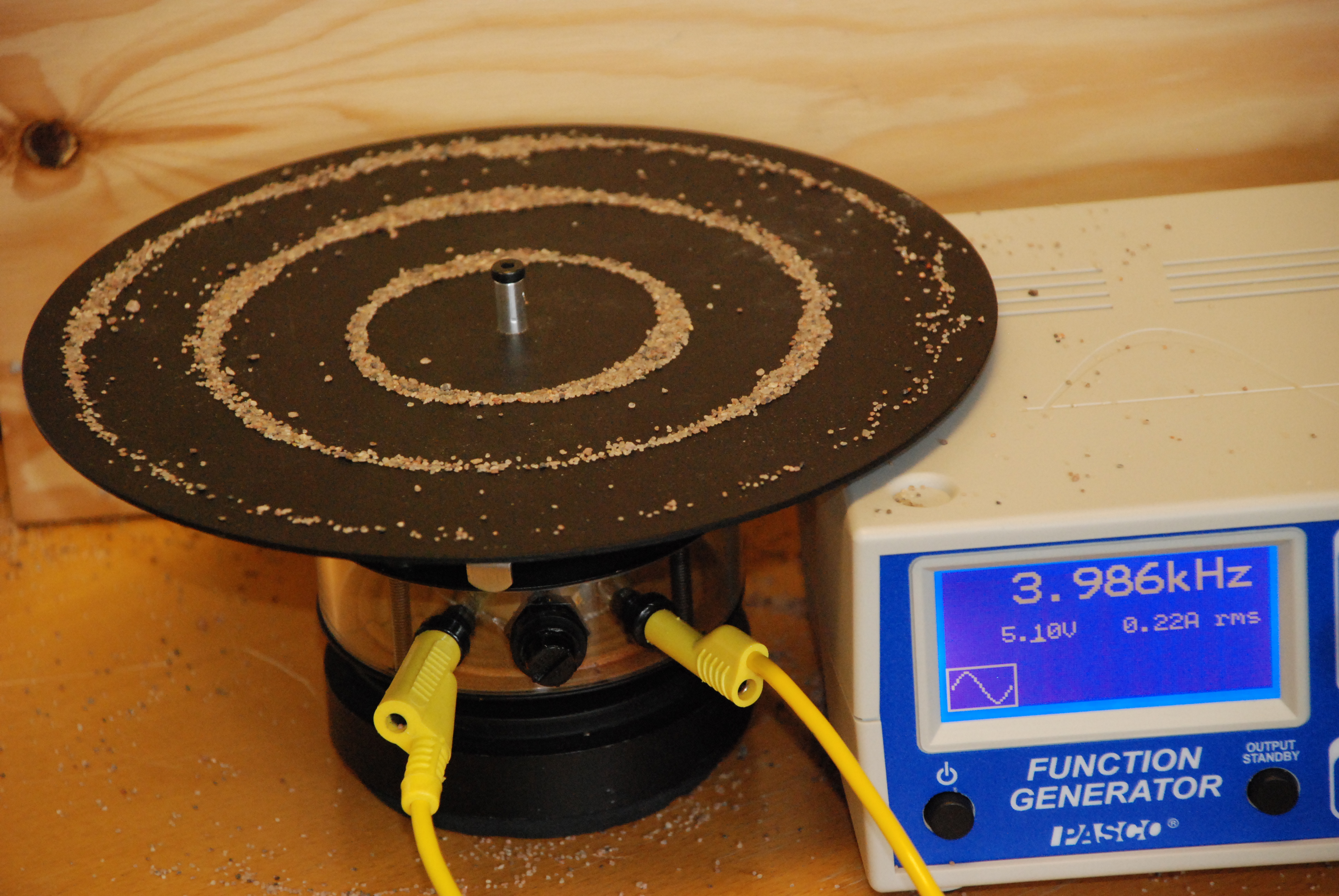
A dark metal disc carries rings of pale sand, like a small diagram drawn on a laboratory bench. The photograph records a Chladni plate in action: vibration has gathered the grains into a pattern. Pieter Kuiper photographed this modern demonstration in 2011; the equipment beside the plate shows a frequency of 3.986 kHz.
Harvard’s lecture-demonstration account explains what the sand reveals. A vibrating plate has regions that move strongly, called antinodes, and nodes where the motion is absent. The sand migrates away from the antinodes and gathers along the nodes. Those lines make a particular mode of vibration visible across the surface. The pattern therefore records the plate’s motion, rather than a drawing placed on it beforehand.
The Harvard apparatus uses brass plates of several shapes, including circles and a square, mounted through their centres. A violin or cello bow supplies the vibration. Touching a point on the edge establishes a node; changing the relationship between that point and the bow can excite a different mode. The result is a family of possible patterns rather than one permanent design.
The Science Museum Group connects the name to Ernst Chladni, the German physicist and musician. Its collection contains two plates that belonged to Charles Wheatstone, whose work extended from telegraphy into optics and acoustics. The individual record linked here, object 1963-202/1, lists brass and lead as its materials and credits King’s College, London. It is a surviving historical instrument, separate from the modern circular plate in our photograph.
Start with Harvard’s explanation for the mechanism, then visit the museum record to see an older object associated with the experiment. The photograph’s credit page supplies the maker’s description and public-domain release, so the visible rings can be examined alongside their documented source.
A documented acoustics demonstration. The photograph shows a modern setup from 2011, not Wheatstone’s museum instrument; the linked Harvard video was not reviewed.
Source details & what was checked
- Harvard Natural Sciences Lecture Demonstrations · Undated
Checked 26 October 2026. Read the full free demonstration account: nodes and antinodes, sand migration, plate shapes and bowed excitation. The linked video was not watched; no broader catalogue review claimed.
Chladni Plates (external source, opens a new tab) · In the source library - Science Museum Group · Undated
Checked 26 October 2026. Read the complete free object record, Chladni and Wheatstone attribution, materials and collection credit. The museum photograph has a noncommercial licence and is not reproduced here.
Chladni plate · 1963-202/1 (external source, opens a new tab) · In the source library