
 Odd Almanac
Added · Daily discovery
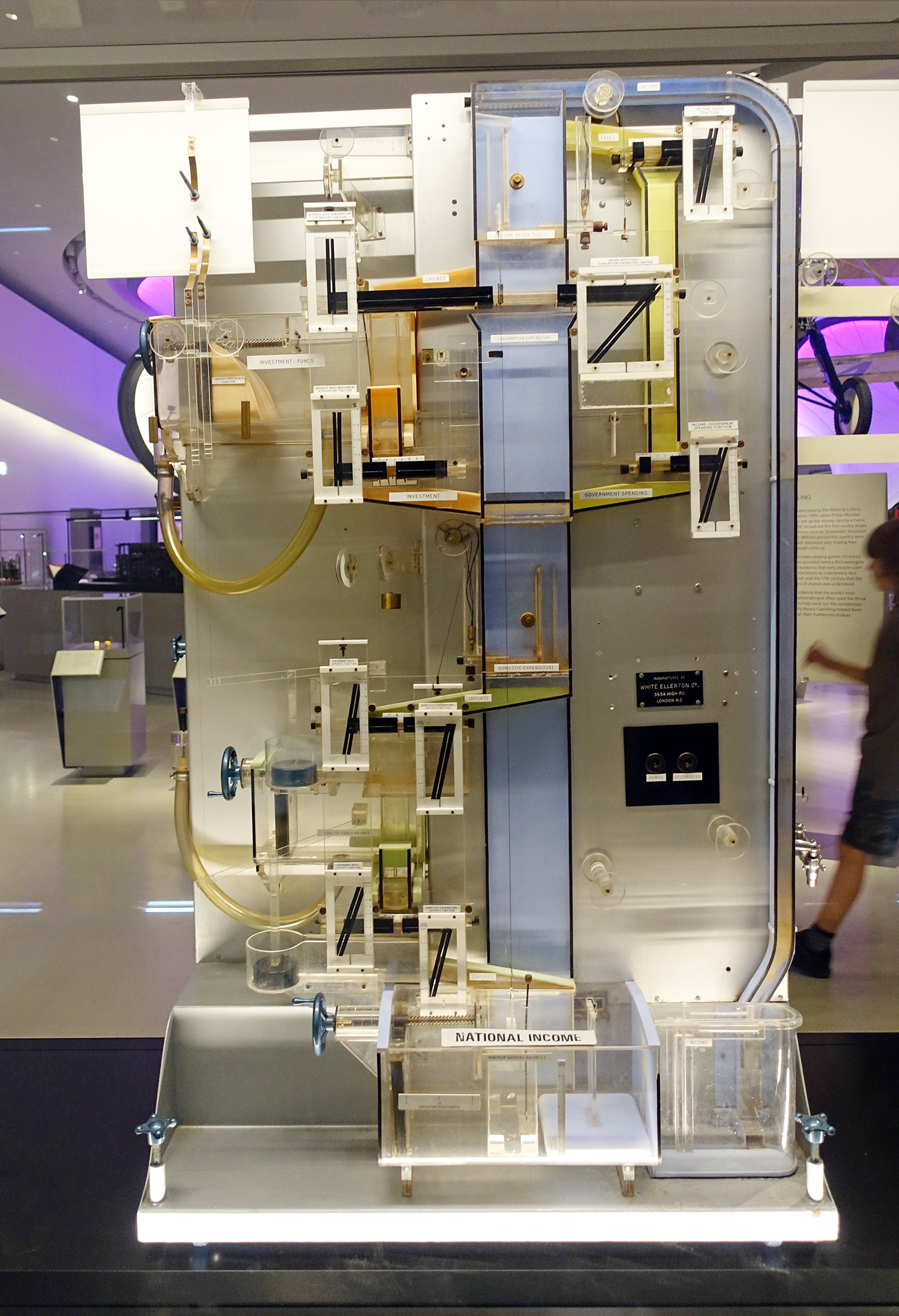
Behind a glass case in London’s Science Museum stands a computer made of transparent tanks, channels and controls. Its labels include investment, taxes and national income. This is MONIAC, a hydraulic model in which moving water makes the circulation of money visible.
The Science Museum dates its machine to 1949 and credits the design to Bill Phillips, a New Zealand-born engineer who became an economist. MONIAC stands for Monetary National Income Analogue Computer. The museum records approximately fourteen machines built; its own example served as a teaching aid at the London School of Economics and ran until May 1992.
The New Zealand Institute of Economic Research describes how the model works. Water is pumped upwards to represent income, then divided among channels for different parts of the economy. Some is diverted as tax; government spending sends it back into circulation. Other streams represent consumption, saving and investment. Imports and exports carry money out of and into the system. These are the relationships built into this particular economic model.
Changing a setting lets students watch the consequences propagate. NZIER’s example follows a change in the tax rate through disposable income, saving and further changes in income. Attached felt-tip pens trace outputs on paper. The apparatus gives the model a changing, physical form, with its results appearing as water levels and drawn lines.
The photograph is Tiia Monto’s 2018 view of the Science Museum exhibit, rather than an image of its original demonstration. Start with the museum’s short catalogue entry for the surviving object, then NZIER’s explanation for the route the water takes. Both treat MONIAC as a teaching model: watching it respond is a way to inspect its assumptions and relationships, not a guarantee of what a real economy will do.
Historical teaching model; no financial forecast or policy recommendation.
Source details & what was checked
- Science Museum Group · Undated catalogue record; object dated 1949
Read full catalogue description, maker/inventor, object details and image rights. Freely readable HTML. The museum photographs have noncommercial terms and are not reused here; Tiia Monto’s separately licensed Commons photograph is used instead. Wider collection branches not certified.
Phillip’s Economic Computer (external source, opens a new tab) · In the source library - New Zealand Institute of Economic Research (NZIER) · Undated institutional account
Read full machine history and What does it show explanation, including tax, consumption, saving, investment, trade and pen outputs. Freely readable without member access. Present-day staff, visiting and location assertions appear historical and are not repeated as current facts. Linked museum branch and wider consultancy/member areas are not recommended or certified.
Moniac machine (external source, opens a new tab) · In the source library